



 Chinese AI Models Outscore Soccer Fans in World Cup Match Predictions
(Yicai) July 14 -- Artificial intelligence models developed by 12 Chinese companies are outperforming millions of human participants in an ongoing 2026 FIFA World Cup forecasting competition, scoring an average match prediction accuracy rate of nearly 66 percent through the tournament's first 100 games.
The contest, jointly organized by Chinese personal computer maker Lenovo Group and streaming service provider Migu Video, pits the 12 AI models against around 35 million human soccer fans, who have a 59 percent mean accuracy rate so far, according to a report released by the co-hosts yesterday.
The humans outperformed the AI models for the first seven days, but have been in second place since June 18. The AIs had got 788 of their 1,200 win-draw-lose forecasts correct after the end of the 100th fixture between Argentina and Switzerland in the quarter-finals on July 12.
The AI lineup consists of DeepSeek, Alibaba’s Qwen, China Mobile's Jiutian, Baidu's Ernie Bot, Tencent's Hunyuan, Moonshot AI’s Kimi, Knowledge Atlas Technology’s Zhipu AI, MiniMax, StepFun’s JieYue Star, iFlytek Spark, SenseTime Xiaohuan, and Lenovo's Tianxi AI.
Hu Yanping, distinguished professor at Shanghai University of Finance and Economics, told Yicai that their performance aligns closely with the 60 percent and 80 percent accuracy that he predicted for them.
“The World Cup prediction contest serves as a practical testbed for evaluating the reasoning capacity and inherent limitations of AI models,” Hu said. “Exposing both their strengths and shortcomings provides tangible insights to guide further optimization.”
According to the report, the AIs are benefitting from the growing availability of information as the tournament progresses, including team form, squad changes, group standings, and tactical trends, amplifying their strengths in aggregating and processing massive amounts of information. In contrast, human judgments are easily skewed by team popularity, personal loyalties, and emotional bias, it said.
Unexpected draws and other "upsets" emerged as a consistent blind spot for the AI participants during the first 100 matches, with all 12 models giving a wrong prediction for 11 fixtures that ended in a draw and in four that were won by a lower-ranked team and hence dubbed upsets.
AI's general deficiency in predicting draws stems from its solid capability to gauge relative team strength, paired with its inability to reliably judge whether this strength advantage can translate into goals within the duration of a match, a dynamic worthy of deeper research, Hu pointed out. However, their failure to anticipate unforeseen in-game incidents falls within expected performance boundaries, he added.
The models have produced highly uniform pre-match projections when evaluating long-standing soccer powerhouse nations, reflecting the influence of historical team strength and resulting in a collective error when those teams suffer unexpected defeats. The 36 forecasts submitted by the AIs for the elimination matches of Germany, the Netherlands, and Brazil turned out wrong.
Predicting correct scores was also a major weakness of the AI models. Out of 1,200 score predictions, only 145 were on the mark for a 12 percent accuracy rate. Even the top-performing model only accurately predicted the exact score 17 percent of the time.
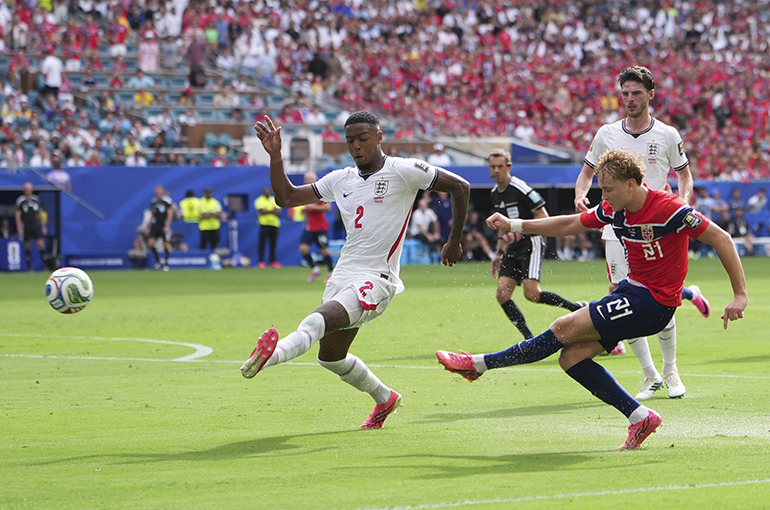
In addition, all 12 models favored Brazil to claim the title, but the nation was eliminated in the 16th round, while none picked England, a nation that has made it into the final four.
Editors: Tang Shihua, Martin Kadiev





