



 Chinese Firms Eye Data Centers, Smart Manufacturing, New Energy Investments in Thailand
(Yicai) July 16 -- Leading Chinese companies have shifted their investment plans in Thailand to data centers, the manufacturing industry's intelligent transformation, and new energy opportunities amid rising land and labor costs and stricter compliance requirements in the country, as well as global tariff shocks.
Internet giants ByteDance and Alibaba Group Holding are investing in Thai artificial intelligence data centers, while leading home appliance firms Haier Group, Midea Group, and Skyworth Group focus on building smart manufacturing bases and developing new energy businesses.
Chinese capital led foreign investment in the Eastern Economic Corridor of Thailand with THB19.5 billion (USD580.7 million) in the three months ended March 31. The country's Board of Investment approved 114 Chinese manufacturing projects over the first four months of this year, which made up nearly 30 percent of the total foreign investment.
Chinese companies' investment focus has shifted to new energy vehicles, humanoid robot components, AI data centers, photovoltaic energy storage, and high-end printed circuit boards.
Haishida Intelligent Technology, a subsidiary of Haier's industrial internet platform COSMOPLat, laid the foundation of its new smart controller plant, with a total investment of over THB2.2 billion (CNY450 million), in Rayong province on June 25. The first phase is planned to cover an area of over 10 acres, have an annual production capacity of 22 million units, and deploy 30 AI agents for planning and scheduling scenarios.
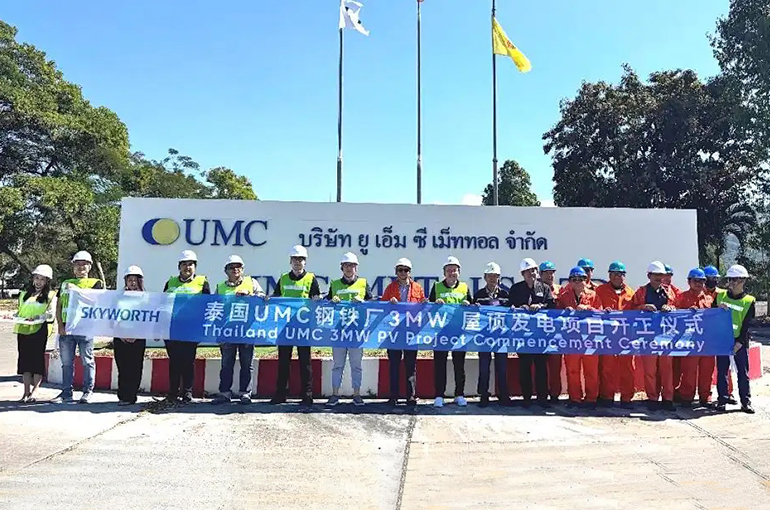
"I went to Thailand last month and will go there again next week," Fu Zhenyu, head of Skyworth PV's overseas business unit, said to Yicai on July 14. "We are promoting 10 industrial and commercial solar projects in the country."
Skyworth PV set up a Thai subsidiary, its first in Southeast Asia, at the end of last year. The unit focuses on large PV power stations, as well as industrial, commercial, and household rooftop solar panels, aiming to build 50 to 80 megawatt PV projects in Thailand this year.
In addition, the THB842 billion (USD25.1 billion) digital infrastructure project of ByteDance's video platform TikTok, which will add servers in Bangkok, Samut Prakan province, and Chachoengsao province and expand data storage and processing infrastructure to support the growth of digital service demand, has been approved by the BOI.
The BOI has also given the green light to robot component projects of Seenpin Electromechanical Transmission, Sanhua Intelligent Controls, Tuopu Group, Xusheng Group, and Better Electronics Technology in the first quarter. Their projects, which have a total first-phase investment of over THB10 billion, will drive the annual procurement of about THB45 billion worth of parts in Thailand, create more than 1,000 new technical jobs, and bring the country its first humanoid robot parts plant.
"The move from Chinese firms is the result of the huge Southeast Asian market and demand for digital industry transformation," Chen Jingwei, general manager of the cloud computing and big data BU of China Communications Services' Gongcheng Management Consulting, told Yicai.
There is a huge e-commerce demand in Southeast Asia, the tariff game between China and the United States has led to the transfer of some industries to the region, and the ban on Chinese chips has forced some computing centers to relocate, Chen said, adding that the Thai government has seized the opportunity to launch many support policies.
The development of Chinese companies in Thailand has shifted from capacity layout and supply chain improvement to intelligent manufacturing, ecosystem co-construction, and breakthroughs in overseas brands, Zhou Xiaoling, information technology director of Midea, said to Yicai. "It is also not solely about land, manpower, and tariff costs but focuses on value chains and ecosystem expansion to achieve sustainable growth."
Editor: Martin Kadiev





