



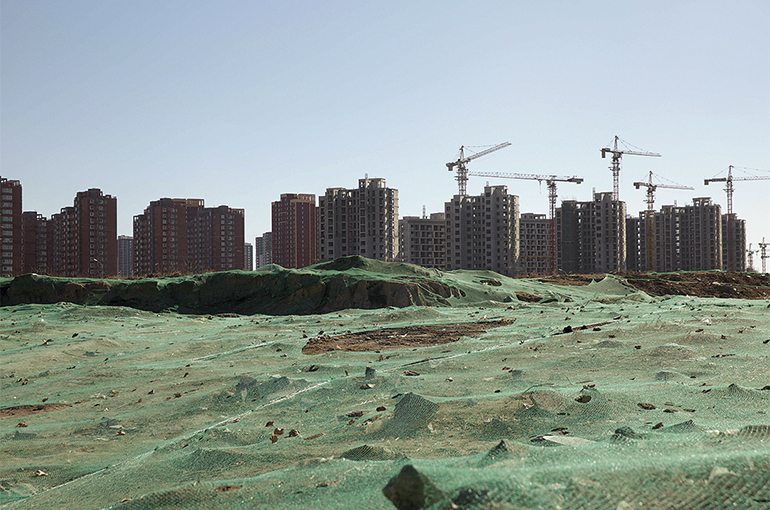
 Chinese Local Gov'ts Log Double-Digit Drop in Income From Land Sales for Fourth Straight Year in 2025
(Yicai) Feb. 2 -- The revenue that Chinese local governments raised from selling land-use rights declined by a double-digit percentage for the fourth consecutive year in 2025, mainly because of ongoing profound adjustments in the real estate market.
Chinese local governments' income from sales of land-use rights plunged 14.7 percent to CNY4.15 trillion (USD597 billion) last year from the year before, according to data the Ministry of Finance released on Jan. 30. The figure fell 16 percent in 2024, 13.2 percent in 2023, and 23 percent in 2022.
In addition, local governments' income from land sales has more than halved since peaking at CNY8.7 trillion in 2021.
Profound adjustments in the real estate market are the direct cause of the figure continuously declining in recent years, Luo Zhiheng, chief economist at Yuekai Securities, told Yicai. "Behind this lies the shift in China's urban housing supply and demand pattern from a previous overall shortage to a coexistence of structural oversupply and insufficient supply of high-quality housing.
"Sluggish sales have put developers in operational difficulties, making them more cautious about land investment," Luo pointed out.
Investment in real estate development in China dropped 17.2 percent to about CNY8.3 trillion last year from 2024, while the area of sold new commercial properties declined 12.6 percent to around CNY8.4 trillion, according to data from the National Bureau of Statistics.
The continuous downward trend in revenue from sales of land-use rights will directly reduce the available fiscal resources of local governments, intensify the tight fiscal balance, increase their debt repayment pressure, and undermine their capacity to invest in infrastructure, which may weigh on their future economic growth, Luo pointed out.
Driven by China's sustained supportive policies for the real estate market, it is gradually moving away from the risk of a hard landing and entering a new phase of adjustment, which is longer in cycle and milder in process, but still ongoing, he said.
Prices in the real estate market will likely stabilize this year due to local governments starting to use funds raised through special-purpose bonds to reserve and acquire idle land, launch high-quality land parcels, accelerate the resolution of builders' existing debt risks, and improve the financing environment, Luo noted, adding that the decline in income from land sales will likely keep declining, but at a slower pace.
Stabilizing revenue from selling land-use rights is premised on a swift "bottoming-out and stabilization" of the real estate market, Luo said. An extraordinary and systematic package of policies is needed to rebuild market confidence with firm determination and strong signals, he added.
The central government should set up a "real estate stabilization fund" to provide special financial support for "ensuring housing delivery" for projects that are in financial distress but have market value, effectively protecting the legitimate rights and interests of home buyers, according to Luo. The fund could also be used to purchase existing idle land and inject critical liquidity into cash-strapped developers, he stressed.
Luo also proposed increasing fiscal support for local governments to fundamentally control and reduce unnecessary land supply and vigorously promote the repurchase of existing idle land, reversing the market's oversupply situation.
In addition, "first-tier cities (Shanghai, Shenzhen, Beijing, and Guangzhou) can further relax house purchase restrictions this year to unlock the suppressed genuine demand, Luo said. “The new changes in first-tier cities can serve as a market benchmark to boost confidence across the national property market.”
High-quality leading builders should be encouraged and supported to integrate peers or property projects facing liquidity strains or operational difficulties through mergers, acquisitions, and restructuring, Luo noted. Other options include lowering interest rates to cut mortgage costs and adjusting tax and fee policies for home purchases to ease the financial burden on buyers, he added.
Editors: Tang Shihua, Martin Kadiev





