



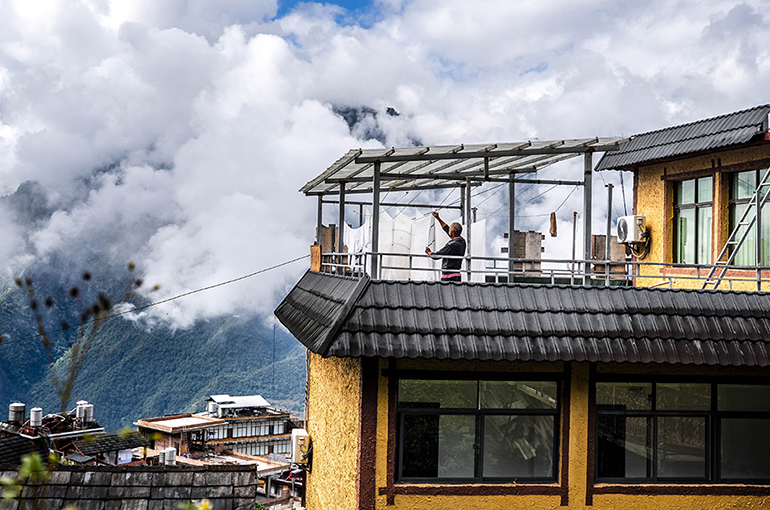
 Chinese Local Gov’ts Promote Health and Wellness Business to Attract Retirees
(Yicai) Aug. 6 -- Some Chinese local governments have issued policy documents to support the development of the health and wellness industry, targeting retired people who have both savings and time to spend.
Qingdao in eastern Shandong province recently released its first policy to promote health and wellness real estate, along with land, financial, and operational measures to support related projects. Meanwhile, neighboring Yantai plans to develop health and wellness tourism, taking advantage of the city’s climate advantages in summer.
Hainan, Yunnan, and Jilin provinces also issued similar policies to support local health and wellness businesses, such as attracting more silver-haired people to settle in or travel.
Shao Min, a retired Shanghai resident, told Yicai that he moved to Jingdezhen, more than 500 kilometers from Shanghai, about 10 years ago after undertaking a major surgery on a friend’s suggestion. He was initially set to stay only for a brief period of time, but decided to stay because of the local air quality, low cost of living, and relaxed pace of life.
In recent years, more and more elderly people from Shanghai have been traveling and moving to Jingdezhen, and some of them are even buying houses there for both short stays and residence purposes.
“More and more elderly people are actively choosing a new way of life by moving to places that are not their home to escape the heat, relax, and have new life experiences,” Shao said.
Besides Jingdezhen, other elderly people from Shanghai also move to Yichun in Jiangxi province, Bama in Guangxi Zhuang Autonomous Region, and other cities in Zhejiang province or Northeast China, he added.
Elderly people are also traveling a lot lately. For example, a Chengdu resident told Yicai that her mother and her friends go to Yunnan province or Guizhou to escape the heat in the summer. “They don’t buy houses there but just rent one for two or three months,” she noted.
The new elderly generation tends to buy properties based on the local living environment, medical resources, living facilities, and community services to improve their lifestyles, rather than on appreciation potential, industry insiders told Yicai.
Therefore, cities with living advantages now have a new source of housing demand. Some of them, with high housing inventory and sluggish population growth, are trying to attract retirees as part of their new development strategies.
In contrast to governments, real estate companies still remain cautious about the opportunities in the health and wellness market. “Everyone knows that the health and wellness real estate business is a window of opportunity, but it is not mature yet,” an employee at a property developer that has already invested in the elderly care business told Yicai.
In his opinion, the biggest challenge of health and wellness projects is not construction but ensuing operation after completion. “Investment in the early stage is large, but there is no mature experience yet in long-term service income and exit mechanism,” he explained.
He believes that the development of health and wellness real estate will be more diverse in the future, with participants including insurance institutions, industry funds, and professional operators besides builders.
Whether the migrant elderly population can become a new driving force for the development of the real estate market will depend on whether a city can truly provide a lifestyle that matches the needs of these people, he added.
Editors: Tang Shihua, Futura Costaglione





