



 Chinese Researchers Discover Gene That Could Enable Multi-Harvest Rice
(Yicai) March 20 -- Chinese scientists have identified a key gene in wild rice that controls perennial traits, a discovery that could allow cultivated rice to be harvested multiple times from a single planting and improve food production efficiency.
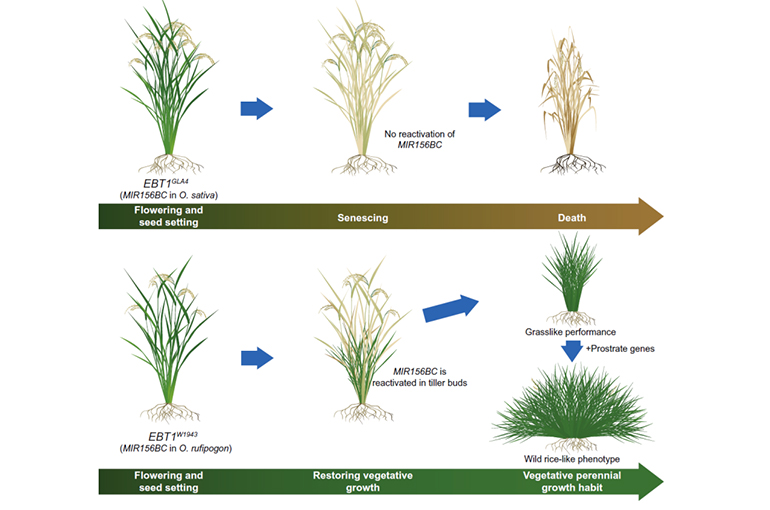
The gene, named Endless Branches and Tillers 1, was identified by a research team from the Center for Excellence in Molecular Plant Sciences at the Chinese Academy of Sciences through forward genetic analysis of hybrids between perennial wild rice and annual cultivated rice, according to a paper published yesterday in Science. The finding provides new insight into the genetic basis of perenniality in cereal crops and could support the future development of sustainable perennial rice varieties.
In the course of rice domestication, perennial genes were not retained, meaning modern cultivated rice must be replanted after each annual harvest. However, some wild rice varieties possess genes that allow them to reverse developmental processes and reset their physiological age, enabling longer lifespans.
If perennial traits can be introduced into cultivated rice, it could enable multiple harvests from one planting under suitable conditions, eliminating the need for repeated plowing and sowing, Han Bin, principal investigator of the study and an academician of CAS, told Yicai. This could help farmers reduce labor demands and mitigate soil erosion.
Based on the research, the team has already developed “wild rice–like” plants capable of reproducing perennial characteristics, though significant work remains before these modified crops can match the yield and nutritional quality of conventional rice, Han said.
“We expect to select and cultivate perennial rice capable of producing 4,500 kilograms to 6,000 kilograms per hectare annually within four to five years,” Han said. “Although this represents a certain decline compared with the annual yield of 7,500 kilograms per hectare for conventional rice, it is worthwhile from the perspective of reducing labor and achieving ecological balance.”
Editors: Dou Shicong, Emmi Laine





