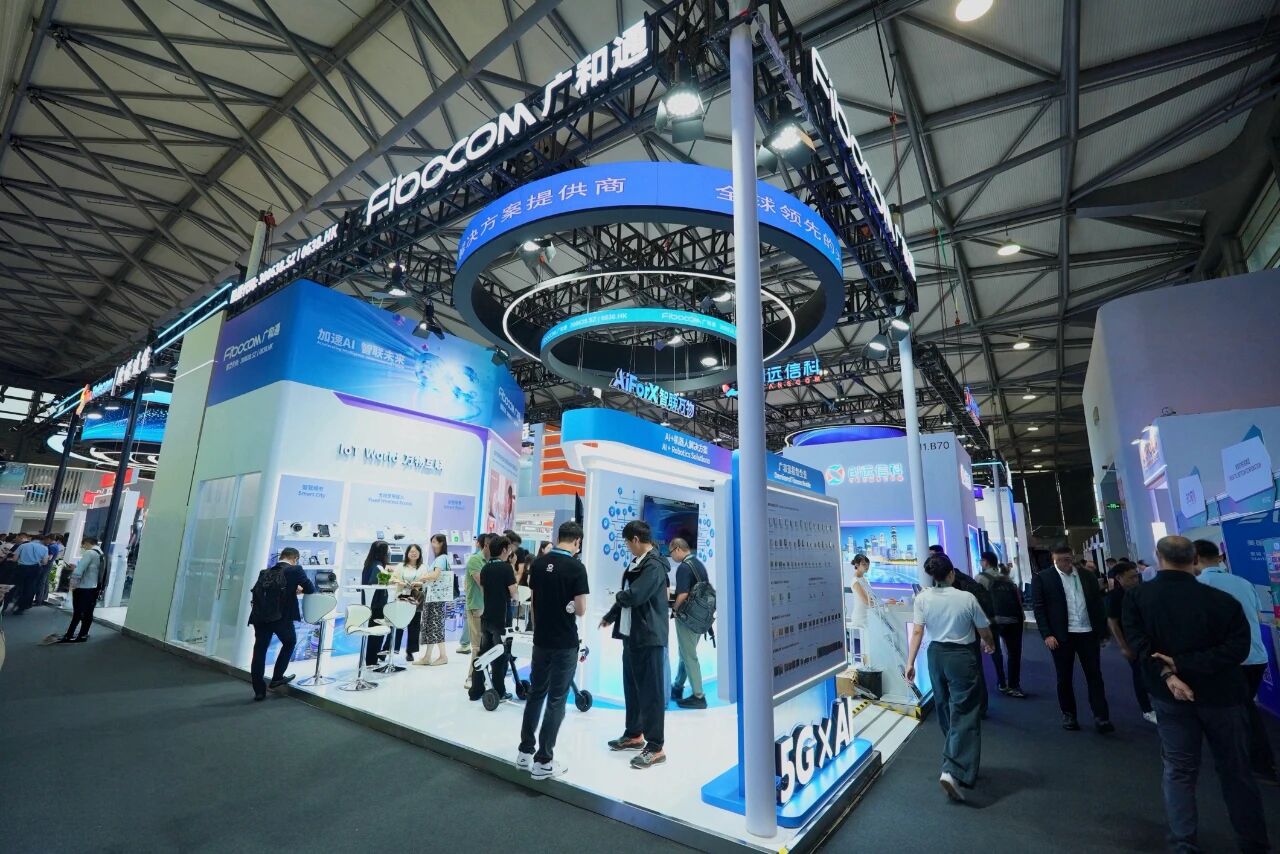
 Chinese Wireless Module Makers Shift From Price Wars to Global Expansion in AI Era, Fibocom Exec Says
(Yicai) June 29 -- Chinese wireless module manufacturers are moving beyond price competition into a new phase of global expansion defined by localized services, high-end customization, and ecosystem collaboration in the artificial intelligence era, according to the vice president of Chinese wireless communication module giant Fibocom Wireless' Wireless Solutions Business Group.
Price wars are a dead end in the module industry, as the average selling prices continue to fall and profit margins narrow, Tao Xi, who is also general manager of the company's mobile broadband division, told Yicai at the Mobile World Conference Shanghai. Fibocom has always insisted on serving large industry clients and leaders, committing to products and business models that deliver real value, rather than competing head-on with rivals on price, he explained.
Expanding overseas has become a way to move away from price competition and promote sustainable development. The top five companies by global cellular internet-of-things module shipments were Chinese in the first quarter of the year, accounting for 71 percent of the total market share, according to data from Counterpoint Research. Fibocom ranked third, with 8 percent.
Fibocom has 12 subsidiaries and offices worldwide, covering more than 100 countries and regions, with manufacturing operations in Brazil, India, Indonesia, and Vietnam. Its overseas revenue neared CNY4.3 billion (USD627 million) last year, accounting for 61 percent of the total.
Fibocom's overseas journey can be split into three stages, Tao said. The first step was to build localized service and supply chain capabilities, the second was to focus on regulatory compliance and ecosystem development, and the third was to provide local customers with high-end and technology-driven customized services.
Different markets call for different approaches. In high-end Western markets where quality and long-term service commitments are paramount, Fibocom has local teams working directly with end-market operators, Tao noted. "Especially in overseas premium markets, customers have very high demands for service and long-term partnerships."
These markets also pay great attention to environmental, social, and governance efforts. In this regard, Fibocom has been releasing annual ESG reports in the past six years to quickly break into premium supply chains in Europe and North America.
In Africa and Southeast Asia, where clients prioritize speed, Fibocom uses flexible delivery channels to respond quickly to demand, while for the Middle East, the company strengthened the thermal tolerance of its products to withstand extreme heat, Tao pointed out.
Fibocom is not just a product exporter but also an enabler for the global semiconductor supply chain. "Many Chinese upstream chipmakers are very strong domestically, but their understanding of overseas markets is relatively shallow," Tao said. By bundling printed circuit board assembly and full-solution offerings around its modules, Fibocom brings its chipmaking partners into markets they could not easily access alone. Moreover, it uses its operator relationships and channels to help downstream clients expand into new regions.
"We want to be an enabler for the ecosystem, help both upstream and downstream partners maximize their commercial returns," he told Yicai.
The joint launch of a 5G dongle solution with Luxshare Precision at Computex Taipei this year -- combining Fibocom's solution design with Luxshare's manufacturing scale and global distribution -- is a recent example of this practice.
The next competitive frontier will be AI devices, Tao believes. As cellular modules grow more commoditized and prices keep falling, differentiation through pure connectivity is fading, so the real value-added will come from AI inference and vertical solutions sitting on top of the module.
"With the arrival of AI, many industries will be reshaped," he said, adding that IoT terminals will evolve from simple network connections into intelligent endpoints with local compute and embedded models.
Fibocom established a platform-level AI research institute several years ago and set up a dedicated robotics product line in 2023. It entered the intelligent lawn mower market and started mass producing its dual-camera flagship product in 2025. Its embodied intelligence platform Fibot has completed on-device deployment of a customer's next-generation large robot model.
According to Sinokan Consulting, the AI module market's revenue is expected to reach CNY8.1 billion by 2029, with a compound annual growth rate of around 49 percent between 2025 and 2029, becoming the fastest-growing sub-segment of the entire module market.
At the MWC Shanghai, AI took center stage. For example, Quectel, the world's largest cellular IoT module vendor by shipments, brought AI modules, edge AI, and robotics solutions, while Meituan Smart Technology displayed AI agents, robotic products, and AI personal computers as its headline items. The focus of multiple Chinese vendors had visibly moved from connectivity to AI capability.
The AI rush brings about some concerns, especially about the commercialization timeline, Tao said. He acknowledged that factories will experience faster adoption, but cautioned that in eldercare or complex everyday scenarios, embodied intelligence still needs considerably more time before reaching commercial scale.
Fibocom is co-developing an embodied intelligence solution with a Western university that would allow robots to handle household tasks, such as folding laundry and washing dishes, through voice commands.
For the company, global competition is no longer just about selling more modules but about exporting localized service capability, supply chain collaboration, and AI solutions, Tao noted, suggesting that this should be the trajectory of China's wireless module industry as a whole.
Editor: Futura Costaglione