



 Climate Action Is Becoming a Key to Competing Globally, Experts Say at Shanghai Climate Week
(Yicai) April 27 -- Climate action is becoming a “new passport” for companies seeking to compete globally as international regulators and buyers tighten scrutiny over supply chain emissions, experts said at Shanghai Climate Week.
"Climate action is no longer corporate social responsibility," said Zou Rong, co-director of the executive committee of the Shanghai Climate Week, which ends tomorrow. “It's become core competitiveness."
The policy backdrop is raising the stakes. The European Union's Carbon Border Adjustment Mechanism has entered its definitive phase, requiring exporters to the EU to account for embedded carbon in ways that carry real financial consequences. Those that cannot measure, verify, and reduce their emissions, including those generated by their suppliers, face growing barriers to European markets.
Salome Chen, co-founder of the China ESG Alliance, described the challenge in broader systemic terms. Building a decarbonized value chain requires alignment among solution providers, enablers, and adopters, she said, adding that this is a degree of coordination that technology alone cannot deliver.
The alliance, which has about 80 member companies, announced five new members at Shanghai Climate Week: Henkel, Schaeffler Group, Reckitt Benckiser Group, M&G Stationery, and consultancy ERM. “Eighty members does not represent a limitation,” Chen said. “It reflects our original intention. We pursue depth and diversity, not scale.”
The Trust Imperative
Alongside technological progress, participants in Shanghai Climate Week highlighted a growing trust gap hindering Chinese firms overseas.
As climate regulations tighten, expectations around ESG disclosure, supply chain transparency, and third-party verification are rising. Industry insiders pointed out that while Chinese companies are advancing quickly in green technology, gaps remain in how their environmental performance is communicated and validated internationally.
Governance transparency and consistent disclosure are becoming essential to building credibility in global markets, said Titan Gu, LinkedIn's East China director and head of talent solutions. “The future currency of trust consists of continuous professional capability, an open talent structure and transparent compliance frameworks,” Gu said.
Supply chain tools that generate verifiable lifecycle emissions data should be used to allow companies to meet increasingly stringent requirements from regulators and customers, noted Zhang Juying, head of strategic sustainability at Schaeffler China.
Exporters now have to navigate overlapping European rules, including the CBAM and broader sustainability reporting requirements, that extend across product lifecycles, said Zhang Xiuxiu, a partner at Huiye Law Firm.
“Rules define the boundaries," said Dong Cheng, also a partner at Huiye Law Firm. "Trust is the only way to cross them."
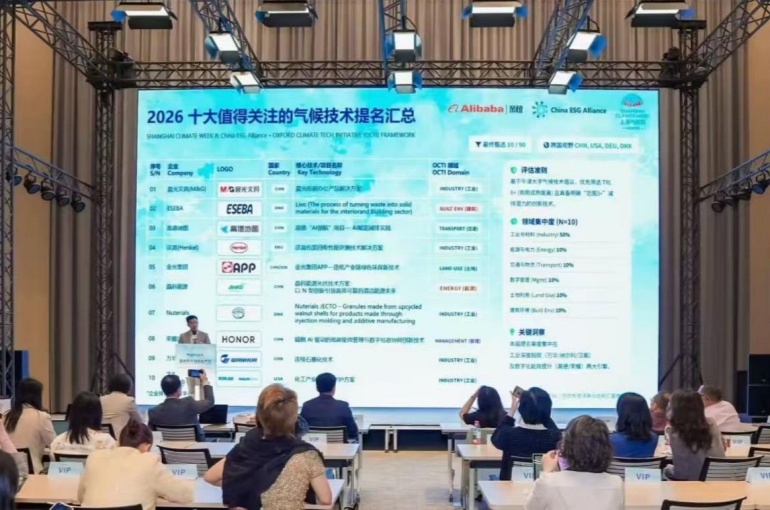
Top 10 Climate Tech to Watch in 2026
The Top 10 Climate Technologies to Watch in 2026 List was unveiled at a forum themed 'Climate and Technology: Reimagining the Future of Green Productivity’, co-hosted by the Shanghai Climate Week, the China ESG Alliance, and Alibaba Group Holding's property management arm.
The list highlights 10 solutions selected for their commercial readiness and their ability to cut emissions across value chains and deliver what is known as “Scope 3+” impact. Experts at the event said climate technology is increasingly becoming a kind of “new passport” for companies hoping to compete globally, as regulators and buyers intensify scrutiny of supply-chain emissions.
Five of the selected solutions came from the industrial sector: Wanhua Chemical Group's continuous graphitization process for battery anode materials, Henkel’s tool for packaging recyclability, Ecolab's chemical process protection technologies, Nuterials' upcycled walnut shell granules for manufacturing, and M&G Stationery’s low-carbon office product line.
Wanhua's continuous graphitization process can cut production cycles to 20 hours from about 20 days while improving thermal energy efficiency by around 80 percent. The company has shifted more than 60 percent of its electricity consumption to green power and is developing wind and solar capacity in China's Shandong province.
Ecolab's processing protection solutions can improve performance within existing industrial systems while reducing their environmental cost.
M&G Stationery’s Eco+Office product line uses recycled materials from waste electronics. Products carry third-party carbon certification under ISO 14067 and are priced on par with conventional alternatives.
German multinational glass company Schott, one of the forum's supporting partners, offered a complementary example of industrial decarbonization. The company has achieved 100 percent green electricity procurement and a 60 percent reduction in carbon dioxide emissions against its baseline.
The firm’s circular economy work has demonstrated that used Schott Ceran ceramic glass cook panels can be reintroduced into production without quality loss, a meaningful advance given that about 1.3 million such panels are thrown away in Germany every year.
The five other solutions that made the list are App Group's paper industry green technology, Eseba's waste-to-solid-materials process for construction, Jinko Solar's N-type photovoltaic modules, Amap's artificial intelligence-powered emissions navigation technology, and Honor's AI energy efficiency management platform.
Amap, Alibaba’s navigation platform, made the list thanks to its AI-powered routing system that reduces fuel consumption across large volumes of daily traffic.
This solution can be referred to as a "Scope 3+ empowerment," where a company's climate impact is increasingly defined by the behavior the firm influences across its ecosystem, rather than its direct emissions only, said Liu Wei, head of ESG strategy at Alibaba.
Editor: Futura Costaglione





