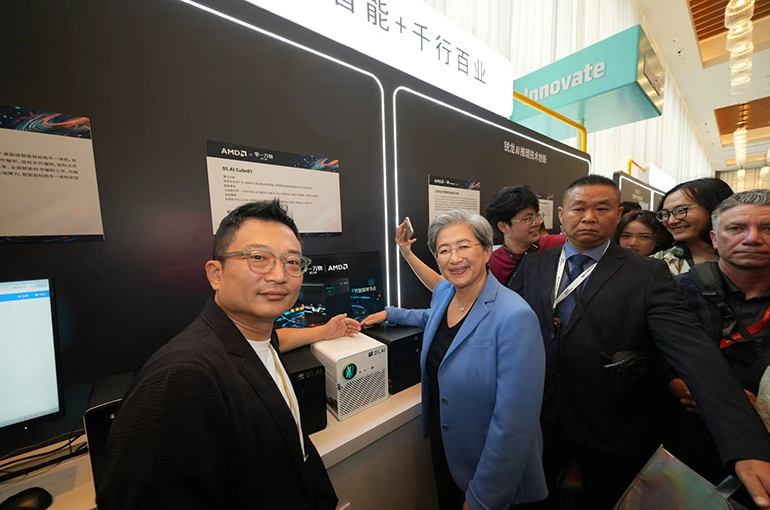
 AMD CEO Predicts AI User Boom Over Next Five Years
(Yicai) May 20 -- Lisa Su, chief executive officer of Advanced Micro Devices, forecast explosive adoption of artificial intelligence over the next five years at the US semiconductor giant’s AI conference in Shanghai.
The number of people using AI on a daily basis could surge to 5 billion by 2030 from over 1 billion last year and just 1 million in 2020, Su said in her keynote speech yesterday at AMD’s first AI Developer Day held outside of the United States.
The AI agent economy will require vast computing power, Su said, adding that what is needed is not a single kind of computing power, but a full-stack system of computing resources that can work together seamlessly.
During a session with Su titled “New Paradigm of Agentic AI,” Kai-Fu Lee, AI expert and founder and CEO of Beijing-based 01.AI, said AI programming capabilities have crossed a critical point. A year ago, he noted, it could only help with writing code, functions, and other such tasks, but now it can deliver a complete set of end-to-end functions. Once AI coding crosses that threshold, autonomous agents become genuinely possible, he said.
More importantly, the industry is gradually recognizing that a single AI agent has limits, Lee said. No matter how large the model parameters are, relying only on one agent’s reasoning ability will eventually hit a bottleneck when facing real, complex problems, he said.
Multi-agent systems have broken through that limit for the first time, Lee pointed out, adding that different agents responsible for planning, evaluation, research, and execution have begun to cooperate, debate one another, and iterate on each other’s results.
Lee stressed that for multi-agent collaboration to work in practice systems must have local-first operation, be processed at the edge, and be able to respond in less than 100 milliseconds. That is where the real winner in hardware competition will be decided, he said.
With AI agents becoming more widely used, Su said, AI has entered the “CPU + GPU” era. From 2022 to last year, the ratio of central processing units to graphics processing units in major deployments may have been 1:4, but it is now moving toward 1:1, she noted.
California-based AMD will focus on “accelerating momentum” this year, Su said, including extending its leadership in computing technologies and data centers.
AMD has over 4,000 engineers at its research and development centers in Beijing, Shanghai, Shenzhen, and Taipei, with its Epyc processors supporting more than 700 cloud instances of China's leading cloud service providers, Su pointed out. The company also has ecosystem partnerships with more than 100 software providers, startups, and universities, she added.
Su expressed confidence in the expanded use of CPUs on AMD’s earnings conference call earlier this month, saying that as AI applications grow, more CPUs will be needed to support AI inference.
Editor: Martin Kadiev