



 EU Chamber Says Growing China-Europe Business Symmetry Offers Stronger Basis for Dialogue
(Yicai) June 5, 2026 -- Chinese companies expanding into Europe are increasingly encountering the same market access barriers and regulatory scrutiny that European firms have long faced in China, a development that could create a stronger basis for dialogue between the two sides, according to European Chamber officials.
As businesses on both sides grapple with similar challenges, policymakers may find it easier to engage in discussions on reducing trade and investment barriers and creating a more level playing field, officials said during a recent briefing on the European Business in China Business Confidence Survey 2026, released by the European Union Chamber of Commerce in China and consultancy Roland Berger.
The growing symmetry in business conditions could help foster more constructive exchanges between China and Europe on market access and investment policies, they added.
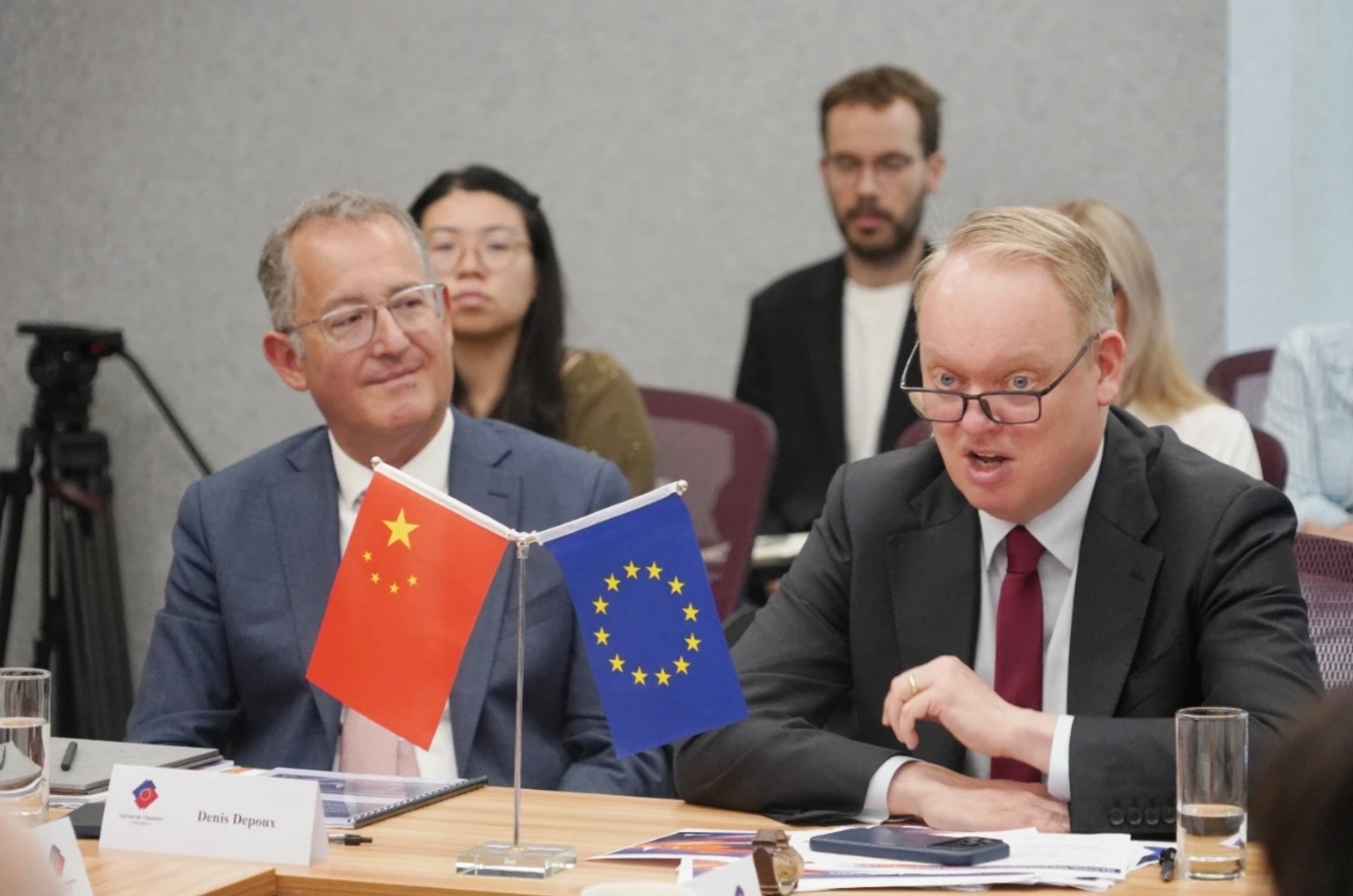
"Somehow it is getting a bit symmetrical," Denis Depoux, global managing director of Roland Berger, said at the briefing. "European companies here are facing some restrictions, some conditions to access the market, sometimes they have even been banned from some markets. Chinese companies in Europe are starting to see the same thing happening."
Depoux described the trend as positive because it creates common ground. "That's a good thing because it's a level playing field," he said. "Two different sides should talk to each other to sort of lower the barriers on both sides."
Creating Local Value
European Chamber President Jens Eskelund said Chinese companies operating in Europe are now "reflecting the exact things, the same being on both sides -- that European companies have been suffering from for so many years."
Eskelund said European companies have historically earned their place in China by demonstrating local value through technology transfers, investment in research and development, localized supply chains, and tax contributions.
"We have been transferring technology. We're moving our R&D here, we are localizing supply chains, we are paying taxes," he said.
Chinese firms investing in Europe will need to take a similar approach, he added. "What Chinese companies need to do is a little bit like what European companies asked themselves -- what can we do to contribute to local development: localized supply, R&D, tax payments, all these things?"
Companies willing to make those commitments would be welcomed, Eskelund said.
"If Chinese companies go to Europe and say: I'm going to create 3,000 jobs. I'm going to work with the local university. I'm going to localize our supply chain -- they will all be welcome," he said. "It's about the value you create, not just import."
China Building Its Own Economic Toolkit
Asked about China's recent regulatory measures, including new rules governing outbound investment and exports of certain technologies, Eskelund compared Beijing's approach with tools developed by the United States.
"We have seen how effective the American tools have been in several instances and how effectively America has been able to impact the countries that they have," he said. "China as a great power -- it's inspiration for that. We need some of that too."
Eskelund noted that China has established regulatory channels through the National Development and Reform Commission and the State-owned Assets Supervision and Administration Commission to oversee state-owned enterprises investing overseas.
"You can read positively the message, which is: please invest in Europe and elsewhere. Also, your technology has been understood," he said.
European companies have spent 20 to 30 years transferring technology and localizing operations in China, helping develop capabilities in other markets, Eskelund said. The strategic value of controlling technology is now increasingly recognized worldwide, he added, giving countries an economic policy tool that may previously have been underappreciated.
'Crisis Fatigue' and China as an Innovation Hub
The Business Confidence Survey 2026 found that 68 percent of respondents said doing business in China became more difficult over the past year, down from a record 73 percent in 2025.
"I don't think that this reveals so much confidence, but rather what was described this morning as crisis fatigue," Depoux said. "Companies have worked on their costs, their supply chains, their product portfolios. As a result, they are more prepared than they were before. Their reaction is easier versus all the volatility."
According to Depoux, European companies have largely adapted to what has become a new operating environment in China.
"It's simply European companies getting more used to the situation and having adjusted to that new normal of fierce competition, slimmer margins, a lot more Chinese competition -- and so they feel a bit less pain than they were feeling two or three years ago."
Eskelund described the overall business mood as "less negative."
At the same time, Depoux said China's role for European companies is increasingly shifting from a manufacturing base and consumer market to a source of innovation.
"China is increasingly a source of product innovation, increasingly a source of core innovation, even research and development -- creativity not only on the product but also on the go-to-market and the services side," he said.
The trend extends beyond the automotive sector into industries including pharmaceuticals, specialty chemicals, and construction materials, he added.
Some automotive original equipment manufacturers continue to maintain R&D and product development teams in China even when they are no longer actively targeting the local market, according to Depoux.
"We're going to see more companies of various sectors that are in China to capture what's going on, to do some research, some developments, some product engineering, some innovation -- but they're not necessarily going to go after the Chinese market," he said.
Administrative Barriers and the SME Gap
Carlo Diego D'Andrea, vice president of the European Chamber of Commerce in China, told Yicai that 47 percent of survey respondents were not making full use of available government support policies and subsidies.
In some cases, companies lack access to information, while in others eligibility thresholds are too high or administrative procedures too complex, he said. The burden falls particularly heavily on small and medium-sized enterprises.
"All the large companies in the world -- they will be here," D'Andrea said. "We should focus more on creating an environment, an ecosystem where SMEs can have access to these subsidies, can access this information." The chamber has observed a decline in the number of SMEs operating in Shanghai, he added.
The survey identified several operational challenges. Some 57 percent of respondents said relocating company operations was difficult, 54 percent cited challenges obtaining construction permits, 53 percent reported difficulties accessing credit or financing, and 65 percent said cross-border money transfers remained problematic.
The chamber's message to policymakers remains unchanged, D'Andrea said. "If they give more market access, companies are willing to invest. This is something that we never get tired of saying to the authorities," he said.
Editor: Emmi Laine





