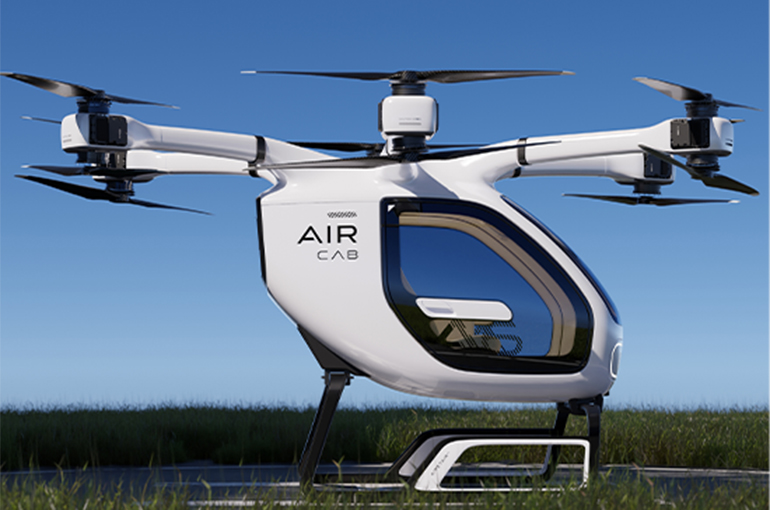
 China's GOVY Targets Commercial eVTOL Services in 2027, Profitability by 2030, CEO Says
(Yicai) June 8 -- GOVY Technology, the flying car brand of Chinese carmaker Guangzhou Automobile Group, will launch commercial operations of manned electric vertical take-off and landing aircraft next year and develop a fully profitable commercial closed loop by 2030, with the industry to experience rapid development over the next five years, according to its founder and chief executive.
The current flying car industry resembles the early stages of the new energy vehicle sector from a decade ago, but it is expected to grow at a faster pace and achieve a full commercial closed loop by 2030, Su Qingpeng said in a recent interview with Yicai. NEVs saw explosive growth after their market share exceeded 7 percent, with flying cars to develop even faster, he noted.
GOVY's first mass-produced flying car model, the GOVY AirCab, launched pre-orders last year, while its first production vehicle rolled off the assembly line last month. The company will complete airworthiness verification and advance Type Certification by the end of this year and obtain Production Certification in the first half of next year before starting ramp-up of mass production and deliveries.
"The delivery ramp-up of flying cars will be slower than that of traditional autos," Su stressed. "During this phase, we still need to keep optimizing products, comply with ongoing airworthiness requirements, and finalize a host of production processes."
The slow production ramp-up of flying cars mirrors the early development of electric vehicles ten years ago, he said, but noted that once airworthiness certifications are obtained, manufacturing processes mature, and production capacity becomes replicable, the flying car sector will see accelerated growth just like EVs.
GOVY's flying car factory is prioritizing the modularization and standardization of production links, including composite material processing and final assembly, to facilitate automated production and building of new plants, Su pointed out.
In addition, the success of flying cars hinges on the large-scale use of solid-state batteries, Su noted. Unlike NEVs that adopt such batteries for different priorities, they can address core needs for flying cars, including long-range flights and high safety, he stressed.
NEV makers place stringent requirements on cost reduction for solid-state batteries, but the manufacturing cost of aircraft is 50 to 100 times that of cars, so battery costs exert a relatively minor impact, Su pointed out. GOVY is ready to adopt solid-state batteries as long as suppliers are capable of small-batch production, he said.
GOVY has completed mixed-ownership reform via equity incentives for core employees and multiple shareholding platforms, with Su revealing that the company plans to go public and is pushing forward with relevant preparations.
Editors: Tang Shihua, Martin Kadiev