



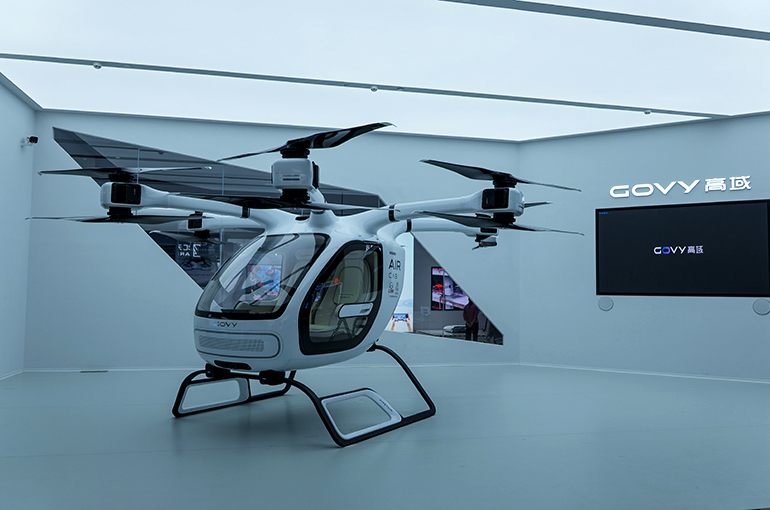
 GAC Group Loses Top Govy Shareholder Spot as Flying Car Developer Plans Taizhou Base
(Yicai) Sept. 28 -- Chinese flying car developer Govy Technology has raised over USD100 million to help fund a new production base in eastern China’s Taizhou, with the financing diluting auto giant GAC Group’s stake and displacing it as the startup’s largest single shareholder.
Govy has secured more than CNY800 million (USD119.2 million) since the start of this year, according to a recent statement by the Guangzhou-based flying car startup. The proceeds will support its push toward mass production and commercial operations.
Yicai learned from Govy's updated business registry records that the firm brought in 12 external investors from provinces including Zhejiang and Hainan in the latest funding round. The largest investor, Chenxi Kaiyuan Yuntu Venture Capital Partnership, is controlled by a capital operation firm backed by the municipal government of Taizhou in Zhejiang province.
Business registry records show Chenxi Kaiyuan has replaced GAC Group as Govy's largest single shareholder, holding a 23.1 percent stake in Govy. GAC Group’s direct holding has been diluted from 34.7 percent to 22.7 percent. Still, Govy said GAC Group and its affiliated funds collectively remain the company’s largest shareholder.
Govy was incubated by GAC Group in 2024, and most of its core management team came from the Guangzhou-based auto giant that owns brands such as Aion, Trumpchi and Hyptec. Govy was once seen as a key part of GAC Group’s push into air mobility.
Taizhou Production Base
The latest financing will advance Govy’s planned intelligent flying-car production base in Taizhou and its expansion across the Yangtze River Delta, the statement said. The proceeds will also fund aircraft research and development, airworthiness certification, mass-production facilities and corporate operating systems.
Local media Taizhou Daily reported on Sept. 24 that Govy signed an agreement with local authorities the same day to build its regional headquarters, a production base for flying cars and key components, plus flight test and evaluation facilities in Taizhou. The project will also host R&D centers, operation hubs, exhibition and sales centers as well as maintenance centers for flying cars.
The project will be developed in three phases. Phase one requires investment of CNY1 billion (USD139 million), with construction scheduled to kick off in the fourth quarter of this year. It is designed for an annual output of 1,000 units of Govy's AirCab product.
Capital Needs Mount
The change in Govy’s largest shareholder is closely linked to its pressing need for financial support, a securities market researcher told Yicai.
The low-altitude economy is an emerging industry whose development involves risks and uncertainties, and securing investment at this stage is key to whether companies can reach mass production, the person added.
China’s leading flying car developers Volant Aerotech, Xpeng's Aridge, CATL-backed AutoFlight, and Geely Technology Group's Aerofugia all completed financing rounds of varying sizes in the first half of this year, according to publicly available information. Volant Aerotech raised a total of CNY3.2 billion (USD475.3 million), while each of the other three secured between CNY1 billion and CNY1.5 billion.
The above-mentioned researcher said electric vertical take-off and landing (eVTOL) development is highly capital-intensive, similar to the early development of new energy vehicles. Although manufacturers can source some components from the automotive supply chain, they still need to develop many parts themselves, making spending more than CNY5 billion on research and development, testing, and other activities reasonable.
A private equity industry insider noted that the entire eVTOL industry remains in an investment phase without revenue and must “build production capacity before creating demand.” Initial product prices and intended orders may change, meaning they remain uncontrollable variables before the products reach the market, the person added.
Certification Challenges
GAC Group previously said Govy had designed annual production capacity of 100 aircraft and planned to complete airworthiness certification by the end of this year.
However, large-scale deliveries remain subject to several constraints, including the availability of supporting urban infrastructure and the development of core component supply chains as well as commercial operation and maintenance systems, the shareholder said.
Several industry players told Yicai that strict requirements for the airworthiness certification of manned aircraft mean that most companies in the industry remain uncertain whether they can obtain the necessary permits by the end of 2026.
Another constraint is whether solid-state batteries, which are particularly important for manned aircraft, can enter large-scale mass production within a short period, industry sources added.
Editors: Tang Shihua, Emmi Laine





