



 Global Leaders Home In on Opportunities From China’s New Five-Year Plan at Development Forum
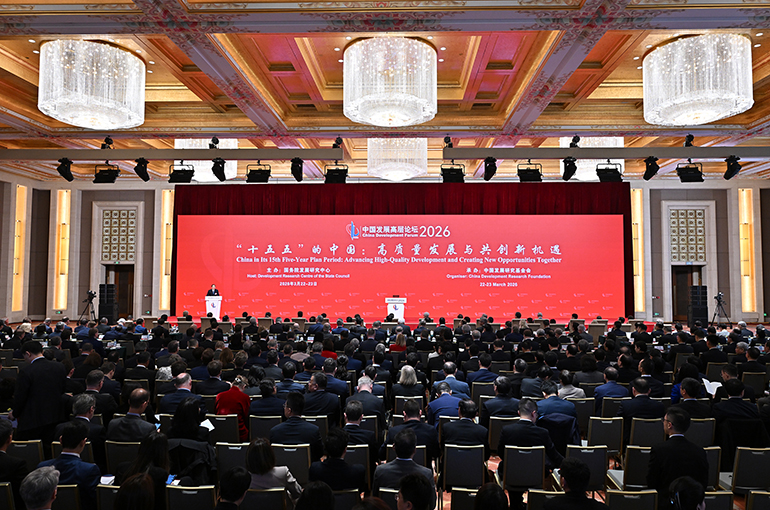
(Yicai) March 23 -- Over 100 representatives from international organizations and Fortune 500 companies focused on social and economic development opportunities brought by China's 15th Five-Year Plan at the annual China Development Forum against the backdrop of Middle East tensions and sluggish global economic recovery.
The outline of the 15th Five-Year Plan is not only a new blueprint for China's high-quality development but also holds new opportunities for the common development of the world, Chinese Premier Li Qiang said at the forum, a key international business conference held in Beijing every year since 2000, which kicked off yesterday.
The country will continue to promote high-quality development, stabilize economic growth, create a first-class business environment, implement national treatment for foreign investment, share the dividends of development with all countries, and jointly promote the stability and security of the global industrial and supply chains, Li stressed.
The Middle East conflict is already driving up fuel and fertilizer prices, threatening growth, employment, and food security, said Anna Bjerde, managing director for operations at the World Bank. "Coping with this uncertainty is only half the task. Countries need to continue investing in reforms."
"The conflict in the Middle East has introduced a significant new source of risk into the global economy," noted Dan Katz, first deputy managing director of the International Monetary Fund. "The full consequences are still difficult to assess.
"China's 15th Five-Year Plan prioritizes increasing consumption as a driver of economic growth, which would also help reduce China's external imbalances," he said.
The 15th Five-Year Plan will focus on expanding consumption and raising domestic demand, accelerating China's transformation from a global manufacturing power to a core global market for demand, said Pan Gongsheng, governor of the country's central bank. China will maintain a moderately loose monetary policy and use a variety of tools, such as reserve requirement ratio cuts and policy interest rates, to keep ample liquidity, he pointed out.
Over the next five years, China's fiscal policy will place greater emphasis on "investing in people" and reasonably increase the proportion of public service expenditures and investment in areas related to people's livelihood, according to Finance Minister Lan Fo'an.
China will always adhere to the basic state policy of opening up, no matter how the international situation changes, said Han Wenxiu, deputy director of the Office of the Central Financial and Economic Affairs Commission. The country does not pursue a trade surplus and has granted zero-tariff treatment on all products from the least developed nations with which it has established diplomatic relations, Han added.
China will promote domestic demand and expand opening up to form a more sustainable trade model and contribute to developing economies through the export of capital goods and overseas investment during the 15th Five-Year Plan, noted Zou Jiayi, president of the Asian Infrastructure Investment Bank.
Editor: Martin Kadiev





