 IMF Cuts World Growth Forecast to 3.1% on Middle East Turmoil
(Yicai) April 15 -- The International Monetary Fund has lowered its forecast for global economic growth this year, warning that it could be cut further if the conflict in the Middle East drags on.
The IMF now expects growth of 3.1 percent for the year through Dec. 31, down from a 3.3 percent forecast made in January, according to its World Economic Outlook report published yesterday. The new projection is well below the historical average of 3.7 percent between 2000 and 2019.
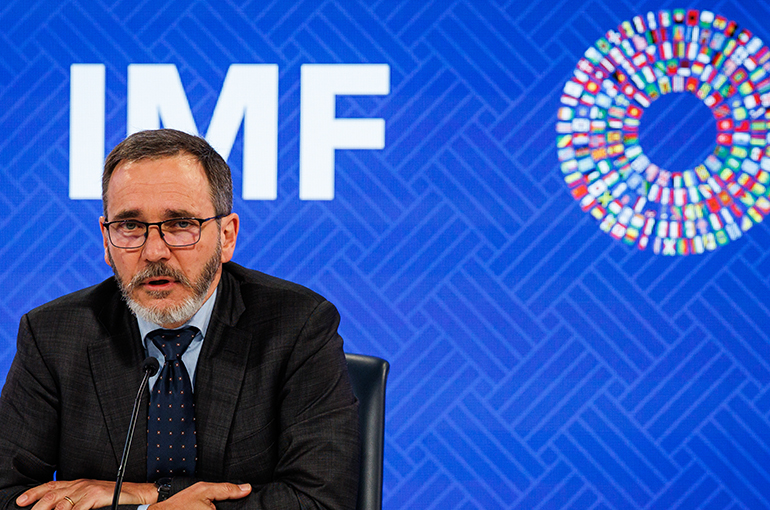
The IMF had planned to raise its growth forecast, but the Middle East conflict has reversed that more optimistic outlook, Chief Economist Pierre-Olivier Gourinchas said at a press conference. If a lasting solution is not found soon, the closure of the Strait of Hormuz and the severe damage to key energy facilities in the region will increase the likelihood of a major energy crisis, he added.
The Washington-based body warned that in severe scenarios in which energy infrastructure in conflict zones suffers severe damage, global growth could be significantly affected in the long term. Under such circumstances, growth could fall to about 2 percent this year and inflation rise to just over 6 percent by next year. Emerging markets and developing economies would be hit almost twice as hard as developed economies, it said.
The IMF also lowered its forecast for China’s economic growth this year to 4.4 percent, down from a 4.5 percent prediction in January. This is much less than the downward adjustment for global economic growth for the same period. It is also an upward revision of 0.2 percentage point from its October forecast.
“The Chinese economy performed strongly in the fourth quarter of last year and to some extent this has continued into this year,” Gourinchas said at the briefing in response to a question from Yicai. “Of course, the situation in the Middle East has also had some impact,” he added.
“Some of the factors behind the upward revision are related to tariff adjustments,” Gourinchas said. “In January, the US Supreme Court ruled that the tariffs imposed under the International Emergency Economic Powers Act were invalid, reducing the effective tariff rate facing China.
“Even if partially replaced by Section 122 tariffs, the overall impact remains favorable to the Chinese economy,” he said, adding that additional fiscal support has also played a role.
Editor: Kim Taylor