



 JD.Com, Amazon Slash Delivery Times to Hours as Overseas E-Commerce Battle Heats Up
(Yicai) March 19 -- China’s JD.com, which launched its e-commerce arm Joybuy in Europe earlier this week, along with the US’ Amazon and other global online retailers, are racing to cut delivery times down to just a few hours, as fast shipping becomes a key battleground amid fierce competition.
JD.com brought its same-day delivery promise to more than 30 European cities this week with the launch of Joybuy on March 16. The platform boasts a “211” delivery promise, in which orders placed before 11 a.m. arrive the same day and orders made before 11 p.m. arrive by 3 p.m. the next day. Just two days after its launch, Joybuy topped the iOS shopping app charts in six countries, namely the UK, Germany, France, the Netherlands, Belgium and Luxembourg.
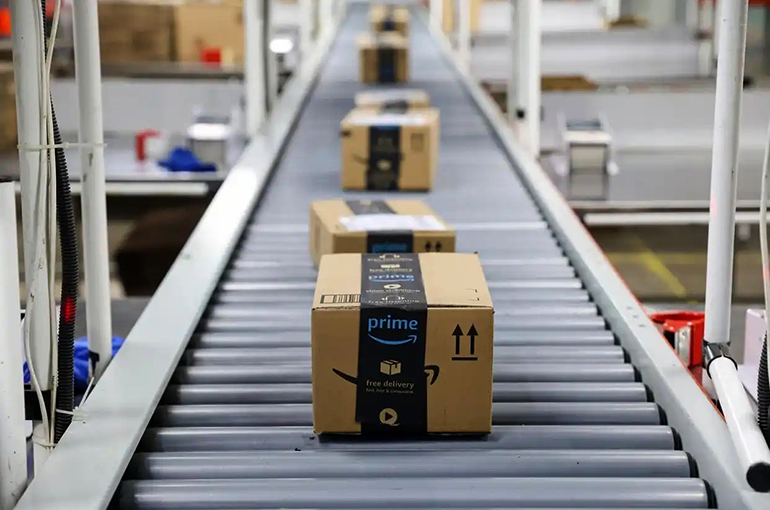
Around the same time, on March 17, Amazon announced the launch of one-hour and three-hour delivery services in hundreds of towns across the United States, covering numerous categories including daily necessities, electronics and over-the-counter drugs. Seattle-based Amazon had previously introduced Amazon Now, a service that can deliver groceries and daily essentials in as little as half an hour in some markets, and which it is now rolling out in multiple countries.
As instant retail rises, delivery speed has become a key battleground for shelf-based e-commerce, Zhang Yi, chief executive officer of market research firm iiMedia Consulting, told Yicai.
In the US, Amazon is facing competitive pressure from multiple fronts. Ride-hailing giant Uber’s financial reports show that its delivery business is growing faster than its ride-hailing business. Meanwhile, retail behemoth Walmart is strengthening instant fulfillment through its store network, with the number of orders delivered within three hours continuing to grow.
By comparison, Hong Kong-based Joybuy still mainly relies on express delivery networks but achieves same-day delivery through a local warehousing and distribution system, positioning itself somewhere between traditional e-commerce and instant retail. JD.com has deployed more than 60 warehousing and distribution nodes across Europe, improving sorting efficiency through automation.
Some European consumers say Joybuy's delivery efficiency is already noticeably faster than traditional logistics services, including DHL.
A platform’s delivery-time strategy is closely tied to the local competitive environment, Zhang said. It is not about being as fast as possible, but about being better than the market average while keeping costs under control. As competition intensifies, if Amazon replicates its faster delivery model in Europe, Joybuy may need to speed things up further, he added.
The continuous push for faster delivery is also amplifying the tension between cost and revenue. Amazon’s expedited services are not free. Prime members pay USD9.99 for one-hour delivery and USD4.99 for 3-hour delivery, while non-members pay even more. A 2025 survey by US consultancy firm McKinsey & Company showed that over 95 percent of US consumers prefer free standard shipping over paid expedited delivery.
Under pressure, Amazon raised the free shipping threshold for non-Prime members in some European markets this month. For example, in Germany, it was raised from EUR39 (USD45) to EUR49. By contrast, Joybuy entered the market with a lower free-shipping threshold, setting it at EUR29.90 in Germany to attract customers with a combination of price and delivery speed.
However, whether it is Amazon or Beijing-based JD.com, their shipping efficiency relies on heavy investment. The European market is geographically fragmented and has relatively low order density, so improving warehouse and delivery network utilization and spreading out the per-unit unit costs will be key challenges. At the same time, stocking local warehouses ties up cash flow, and the risks of unsold inventory and price fluctuations cannot be ignored.
Zhang pointed out that the core challenge of a heavy asset model lies in matching scale with efficiency. E-commerce platforms still need to find a sustainable balance between efficiency and cost.
Editor: Kim Taylor





