



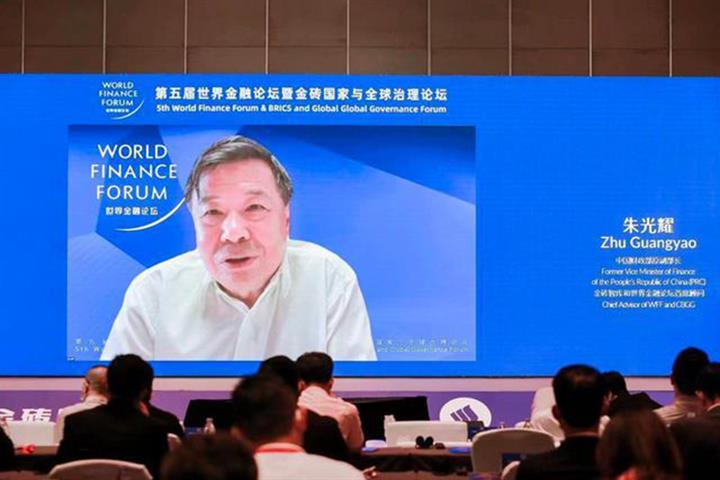
 Only G20 Can Lead World Out of Current Crisis, China’s Ex-Vice Finance Minister Says
(Yicai Global) July 13 -- Only the Group of Twenty, comprising 19 countries as well as the European Union, can steer the world and prevail against the most severe systemic crisis since the Second World War, as the Group of Seven has proved incapable of doing so, according to a former Chinese vice finance minister.
During the 2009 G20 Summit in Pittsburg, it was declared that the group, whose members account for about 90 percent of world production, would be a major platform for global economic governance, Zhu Guangyao told the fifth World Finance Forum and the BRICS and Global Governance Forum held in Shenzhen at the weekend.
The G20’s cooperative spirit, political influence and economic strength guided the world out of the 2008 financial crisis, said Zhu, who is now chief advisor to the WFF and the Center for BRICS and Global Governance. He said it represents a future development trend that will promote strong, sustainable and inclusive growth in the global economy.
Globalization has been facing huge challenges due to the ongoing Covid-19 pandemic and geopolitical crises, Zhu said. Some nations have put up barriers, which seriously impact globalization’s future expansion. Using the Indo-Pacific Economic Framework as an example, the four pillars of this framework are based on the design of an exclusive economic structure.
Moreover, the monetary policies of developed economies such as the United States have “turned sharply,” the risk of a potential food crisis is constantly escalating, and the world is now in the midst of a global systemic crisis, Zhu said.
Facing the worst crisis since the Second World War, all countries need to recognize the urgency of maintaining peace and development, which is the theme and task of this era, he said, adding that major economies in particular should communicate and coordinate on policies in a timely manner.
China's Role
China has now entered an institutional opening-up phase, moving on from the previous commodities opening-up stage, said Tu Guangshao, senior advisor to the WFF and the Center for BRICS and Global Governance. China has been injecting new vitality into globalization and the world’s economic growth by insisting on, expanding and deepening the scale of its opening-up.
To spur the opening-up of China’s capital markets, full play needs to be given to the leading roles of the Yangtze River Delta region, where Shanghai is located, the Guangdong-Hong Kong-Macao Greater Bay Area, where Shenzhen is located, the Hainan Free-Trade Port and many other significant regions, not to mention important platforms and collaborative mechanisms, such as the BRICS nations, the Regional Comprehensive Economic Partnership, the world’s largest trade pact, and China’s Belt and Road Initiative, said Tu, who is also honorary chairman of the Shanghai Development Research Foundation.
China must execute institution-related opening-up as well as adherence to international systems and standards in important sectors such as global sustainable development, digital finance and financial technologies as well as increase investment in the environment, society, and governance.
Fragmented World
Globalization is becoming increasingly fragmented, said Marcos Troyjo, president of the New Development Bank. Emerging economies account for an increasing share of the world’s gross domestic product and more and more emerging economies are playing an increasingly significant role in global affairs, he said.
Developed nations and emerging economies should deepen their collaboration, especially partnerships in important sectors such as infrastructure and sustainable development, so as to facilitate rapid global development, Troyjo said.
The world is in the process of deglobalization, a major concern, according to Michael Spence. In the future, many people will endeavor to replace the traditional status of the US dollar with other currencies, the Nobel economics laureate in said.
The Chinese yuan will become increasingly important and play a more significant role in the global trade and financial systems, he said. This trend will continue, enabling the world to move towards a multipolar system. The more global sanctions imposed by the US, the more detrimental it will be to strengthening the US dollar, Spence added.
Editors: Xu Wei, Kim Taylor





