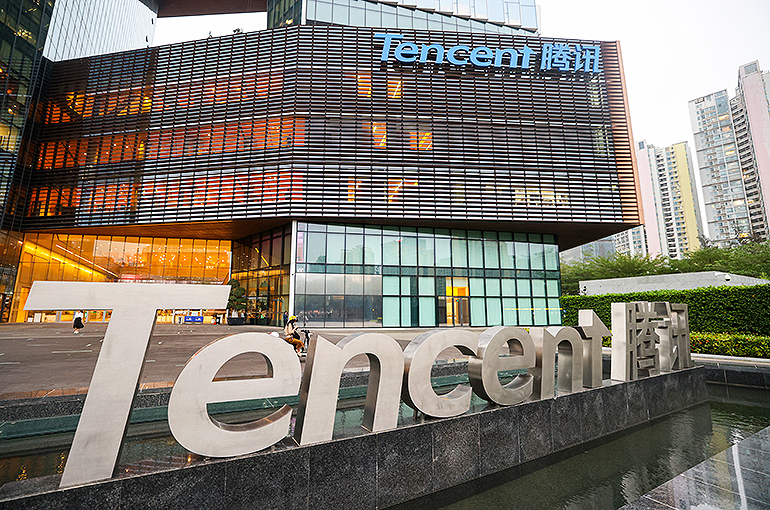
 Tencent Is Making Good Headway in Building an AI-Empowered Future, Pony Ma Says as Capex Almost Triples
(Yicai) Aug. 13 -- Tencent Holdings' second-quarter results have underscored the scale of its ambitions in artificial intelligence. After nearly tripling capital expenditure from a year earlier to ramp up investment in AI infrastructure, founder Pony Ma said the Chinese internet giant is making great strides in becoming an AI-empowered version of itself.
“We’re making substantial progress toward building a new AI-empowered Tencent in terms of intelligence, applications, and infrastructure,” Ma, who is also chairman and chief executive, said yesterday on the Shenzhen-based firm’s second-quarter earnings conference call. “At the infrastructure level, we substantially stacked our power procurement of compute, which will enable us to convert usage of our applications and models into revenue going forward.”
Capital expenditure topped CNY52.8 billion (USD7.3 billion) in the three months ended June 30, up 176 percent from a year ago and 65 percent on the prior quarter. Net cash plunged 60 percent to CNY5.8 billion (USD860 million) from the end of March, mainly due to capex and dividend outlays.
Tencent has faced criticism for lagging domestic rivals such as ByteDance, Alibaba Group, and Baidu in developing AI. Its chief AI scientist rejected that narrative last month, arguing that “AI is a long-term game” and that, in many respects, “the second half of the AI race is only just beginning.”Having ramped up spending, Tencent has become an aggressive contender in the AI race.
“We're comfortable making significant investments in AI because not only is there a substantial upside potential, there is also clear downside protection,” President Martin Lau said on yesterday’s call. “The AI investments we're making are mostly in AI infrastructure, and in the worst case scenario, which we don’t believe will happen, we can choose to rent that infrastructure out at cost recovery or even better prices via Tencent Cloud."
Allocating existing computing resources to Tencent Cloud's leasing business can generate sizeable revenue, Lau noted, adding that prepayments and related orders Tencent made several months ago can be resold at a profit margin of more than 30 percent.
Nevertheless, Tencent prioritizes computing resources for building its own models and applications, with only surplus capacity made available for leasing, Lau stressed. The company plans to gradually build high‑margin, cash‑generating AI‑native businesses, he added.
Lau also pointed out that investors should not assume such big AI investments will occur every year, adding that spending on computing power for inference would only proceed if it is guaranteed to yield substantial returns.
Quarterly Earnings
Net profit rose 0.7 percent to CNY56 billion in the second quarter from a year earlier, falling short of expectations. Revenue topped CNY204.8 billion (USD28.2 billion), up 11 percent year on year and 4 percent quarter on quarter.
Tencent’s shares [HKG: 0700] ended down 4.5 percent at HKD441 (USD56.20) each in Hong Kong today, giving it a market capitalisation of HKD4 trillion (USD510 billion).
Profit based on non-IFRS rules reached CNY75.6 billion, rising 9 percent from a year ago while staying flat from the first quarter. Excluding the impact of AI‑related spending, non-IFRS profit jumped 19 percent to CNY86.1 billion year over year.
Revenue from value-added services climbed 8 percent to CNY98.4 billion, while that from marketing services jumped 22 percent to CNY43.6 billion, and that from fintech and enterprise services gained 9 percent to CNY60.3 billion.
Among Tecent's value-added services business, income from social networks rose 0.8 percent to CNY32.5 billion, while gaming revenue jumped 11 percent to CNY65.9 billion. The number of combined monthly active accounts on super-apps Weixin and WeChat increased by 2 percent to 1.44 billion.
For the first half of this year, non‑IFRS profit added 9 percent to 151.3 billion, while revenue gained 10 percent to CNY401.2 billion.
Editors: Tang Shihua, Martin Kadiev