 Robots to Take Over Production at Gree’s Smart Aircon Factory
(Yicai) Dec. 11 -- Gree Electric Appliances is set to launch a fully unmanned third production line at its intelligent factory in Zhuhai, southern Guangdong province, paving the way for future Gree air conditioners to be manufactured and packaged entirely by robots, the general manager of one the Chinese home appliance maker’s subsidiaries told Yicai.
The factory’s smart production model will gradually be rolled out to Gree’s other 13 air conditioning production bases across China, as well as to its factories that make other products, said Chen Huadong, general manager of Gree Electric Appliances (Zhuhai Jinwan), which operates the plant.
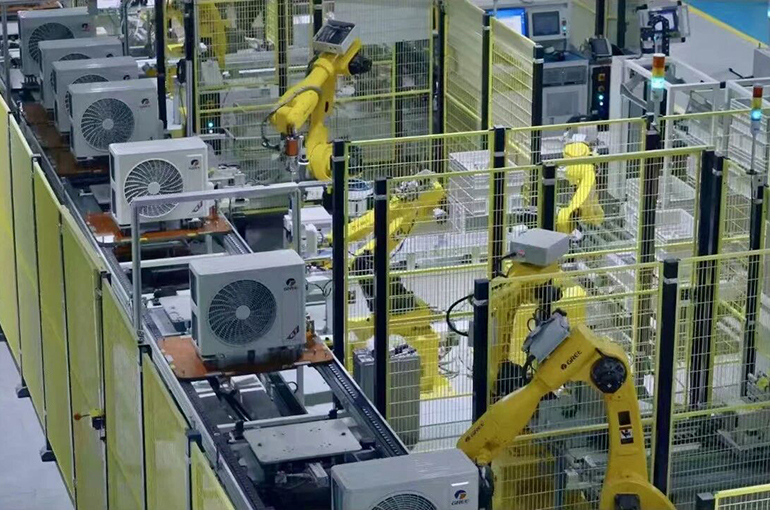
The smart factory, which began operations in 2023, currently has two automated production lines. Robots and smart equipment dominate the factory floor. The two lines together use over 2,000 industrial robots, cutting the number of human workers per line from the usual number of more than 70 to just over 20 and boosting automation to 80 percent.
Processes such as loading components, welding, installing parts and testing are all automated, Yicai noted during a site visit. Even tasks like sticking on product labels and packaging are done by robots. When the robot places an air conditioner into a box its bionic hands even give the boxes a good shake to ensure the product fits snugly.
By integrating vision and sensing technologies, along with the use of system algorithms and large language models, the factory's robots seem to have eyes, ears and hands, said Production Line Manager You Yicheng. For example, the robot that tightens screws can decide how it will operate and independently retrieve the data it needs during production.
AI has replaced manual inspections in the factory, You said. More than 300,000 pieces of data were collected during two years of trial operations which were used to train the AI system to detect faulty sounds and unusual noises that could signal potential problems.
Before each air conditioner rolls off the production line, it undergoes performance tests using smart devices, You said. Tasks that were once entirely done by workers through visual, audio, and tactile inspections are now fully carried out by AI equipment.
Early Start
Gree began investing in smart manufacturing in 2013, Chen said. The Jinwan plant integrates all of the Zhuhai-based company's technological advantages and serves as the mother factory for Gree's intelligent manufacturing capabilities.
To solve the initial challenges of software incompatibility, data connectivity issues and inconsistent standards across departments, Gree worked with several Chinese universities and research institutions to build an industrial Internet platform, Chen said. It took one to two years to get all systems connected and communicating smoothly.
The upgrades in automation, digitalization and networking at the Jinwan factory laid the groundwork for full smart operations, enabling coordinated management across the entire value chain.
Increased Efficiency
Gree's Jinwan factory, which has a total investment of CNY15 billion (USD2.1 billion), is designed to produce 12.3 million air conditioners a year with an annual output value of CNY18 billion, Chen said. The two pilot production lines have already been operating for two years.
The factory's Phase I project broke even this year, Chen said. Thanks to its smart manufacturing network, the development cycle for new products has been cut nearly in half, production efficiency has almost tripled and inventory turnover has accelerated by 36 percent.
Editors: Tang Shihua, Kim Taylor