



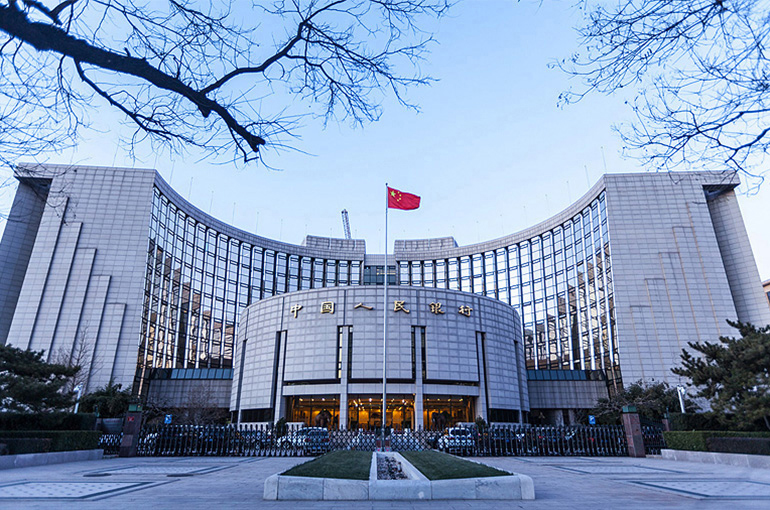
 PBOC Injects USD145 Billion Into China’s Banking System, Dimming Prospects for Reserve Ratio Cut
(Yicai) Feb. 13 -- China’s central bank conducted a CNY1 trillion (USD145 billion) outright reverse repo operation today to maintain ample liquidity in the banking system, making a cut in the amount of cash commercial banks must hold in reserve less likely, analysts said.
The operations would have a fixed quantity and be carried out through interest-rate bidding, with winning bids determined at multiple price levels, the People’s Bank of China announced yesterday. It would have a tenor of six months.
Outright reverse repo operations, a tool the PBOC introduced in October 2024 to manage banking system liquidity, are conducted each month with a tenor of no more than one year. CNY700 billion (USD101 billion) with a three-month tenor and CNY500 billion with a six-month tenor will mature this month.
The amount added by the PBOC has diminished the urgency and possibility of a reduction in the reserve requirement ratio in the near term, especially before the Lunar New Year holiday, said Dong Ximiao, chief researcher at Merchants Union Consumer Finance and deputy director of the Shanghai Institute for Finance and Development.
After injecting liquidity through various monetary policy tools, observing the effects first and holding off deploying an aggregate tool such as a comprehensive cut in the RRR is in line with China’s current policy thinking, Dong pointed out.
But today’s action does not entirely rule out the possibility, as an RRR reduction remains an important option in the central bank’s toolkit, he said.
The PBOC conducted a CNY800 billion three-month outright reverse repo operation on Feb. 4, which, combined with today’s operation, takes the net injection to CNY600 billion this month, up CNY300 billion from last month and marking the ninth straight month that the bank has injected medium-term liquidity into the market via outright reverse repos.
Holiday Cash
February is a month of concentrated bank lending, Dong noted, adding that this, coupled with increased cash withdrawals before the Chinese New Year and other factors, has stoked the demand for liquidity.
The PBOC’s large-scale, over-renewal of outright reverse repos before the holiday sends a positive signal of maintaining abundant liquidity and safeguarding the stability of the financial market, Dong pointed out.
This year’s Lunar New Year holiday, known as the Spring Festival in China, will run for nine consecutive days from Feb. 15 to 23. That is one day more than in previous years, making it the longest Spring Festival on record.
To meet the funding needs of major projects in priority sectors and reinforce the economic recovery, this year’s additional local government debt quota has been allocated in advance, said Wang Qing, chief macro analyst at Golden Credit Rating International. This suggests that despite the upcoming holiday, some government bonds will be issued, he added.
The PBOC’s CNY500 billion new financial tool was fully deployed last October, and it is expected to trigger a substantial expansion in associated bank lending this quarter, Wang noted, adding that all these factors together could tighten the money supply.
Against this backdrop, the central bank’s use of outright reverse repos to inject medium-term liquidity into the banking system helps maintain relatively stable and ample funding conditions ahead of the holiday, underscoring the continued supportive stance of monetary policy, he said.
In addition, CNY300 billion in medium-term lending facility loans will mature this month, which the PBOC may roll over at the same or slightly higher amount, Wang believes.
The bank will provide further liquidity support through MLF loans and treasury bond trading tools this month, according to Ming Ming, chief economist at Citic Securities.
Editor: Futura Costaglione





