



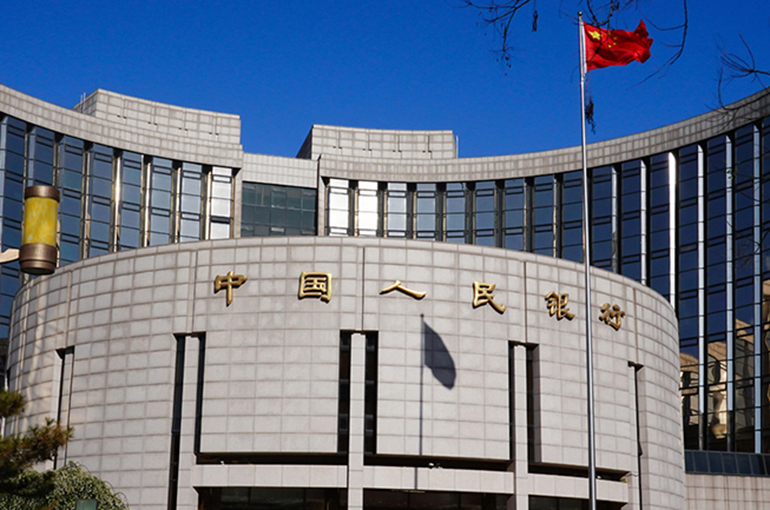
 China May Cut Reserve Requirement in First Quarter of 2026, Lower Rates in Second Quarter, StanChart Says
(Yicai) Dec. 12 -- China’s central bank is likely to cut the reserve requirement ratio in the first quarter of next year and lower interest rates in the second quarter, while relying more on other policy tools to keep liquidity ample, according to Standard Chartered’s chief economist for China and North Asia.
The forecast, made by Ding Shuang at the 2026 Global and China Economic Outlook Conference held yesterday, comes as policymakers face limited room for monetary easing amid historically low net interest margins at Chinese banks and the need to safeguard the yuan’s purchasing power.
The RRR cut is expected in the first quarter of next year, with a reduction of 25 basis points and the interest rate cut is predicted to occur in the second quarter, with a reduction of 10 basis points, Ding said. He added that the People’s Bank of China is likely to normalize its buying and selling of government bonds in the secondary market to maintain reasonably sufficient liquidity and prevent a rise in market funding rates and excessively high government bond yields caused by a surge in government bond supply.
Ding said banks’ net interest margins have already fallen to historic lows, meaning the central bank’s scope for rate cuts is relatively limited. He expects only one interest rate cut and RRR reduction throughout 2026, with rate cuts increasingly serving as a signaling tool rather than having a strong impact on financing costs or credit demand.
According to Ding, the central bank will be more cautious than in the past when implementing a moderately accommodative monetary policy, in order to preserve the yuan’s purchasing power and enhance its international credibility. This does not mean policymakers will artificially boost the currency’s value, he said, but rather create conditions for yuan appreciation through structural measures such as increasing investment in technology, improving labor productivity, and maintaining a certain trade surplus while becoming more tolerant of currency strength.
Ding said China’s macro policies are expected to remain supportive until the property sector stabilizes, but are unlikely to turn more expansionary. He projected that the fiscal deficit ratio in 2026 will edge down from around 4 percent this year to about 3.8 percent, while the broad fiscal deficit as a share of gross domestic product will slip to around 8.5 percent. Annual issuance of central and local government bonds is still expected to be close to the 2025 level.
China is managing risks through economic transformation, Ding said, noting that greater emphasis is being placed on boosting labor productivity via technological investment and industrial upgrading, as well as fostering new growth drivers as the external environment changes. As a result, domestic-demand-led and innovation-driven growth is expected to become more prominent in 2026.
Ding also forecast that inflation will remain low next year, with consumer prices seeing a mild rebound and producer price declines narrowing. Exports are expected to maintain relatively strong growth, though slower than this year, while the contribution of the trade surplus to GDP will decline.
Service consumption is likely to grow steadily, Ding said, but the contribution of goods consumption to GDP may slip slightly as trade-in policies for consumer goods are unlikely to be expanded further. While real estate investment is expected to remain in negative territory, the overall contribution of investment to GDP could see a modest rebound.
Editors: Tang Shihua, Emmi Laine





