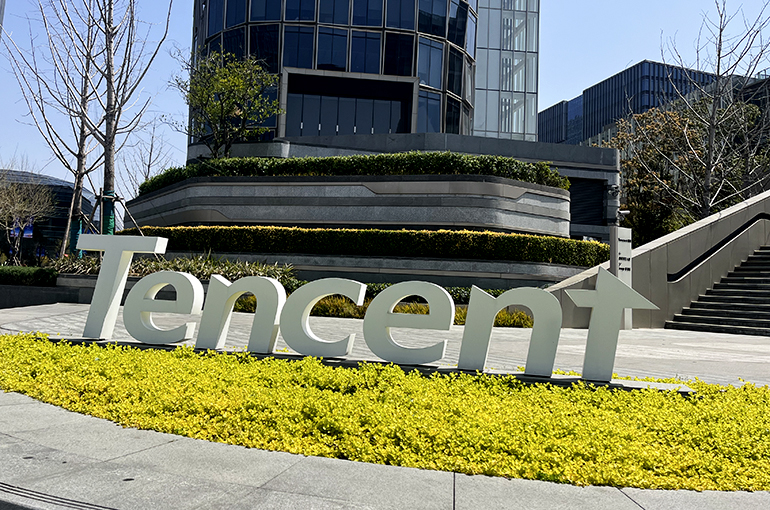
 Tencent’s First-Quarter Profit Jumps 21% as Capex Tops USD4.4 Billion on AI Spending
(Yicai) May 14 -- Tencent Holdings reported a 21 percent jump in first-quarter profit, with the Chinese internet giant ramping up capital expenditure by more than CNY30 billion (USD4.4 billion) as it goes all out on artificial intelligence.
Net profit was CNY58.1 billion (USD8.6 billion) in the three months ended March 31, the Shenzhen-based company said in a financial report released yesterday. Based on non-international financial reporting standards, profit climbed 11 percent to CNY67.9 billion from a year earlier.
Revenue rose 9 percent to CNY196.5 billion (USD28.9 billion), while gross profit increased 11 percent to CNY111.3 billion, with gross margin rising to 57 percent from 56 percent.
When asked at a shareholders’ meeting the same day whether Tencent lags on AI, founder and Chief Executive Pony Ma went for a nautical metaphor. “One year ago, we thought we had boarded the ship, but later found out that the ship was leaking,” he said. “Now, we feel like we're standing on the ship, but still can't sit down. We still hope the ship can move faster.
“The firm's reorganized AI research and development team has rebuilt the AI infrastructure and formed the Hy3 preview model, which is leading in performance among models of the same parameter scale,” Ma, who is also chairman, pointed out.
Tencent's operating profit rose 9 percent to CNY75.6 billion based on non-IFRS, with operating margin stable at 38.5 percent. Excluding new AI products, non-IFRS operating profit would have grown 17 percent to CNY84.4 billion.
Tencent’s shares [HKG: 0700] added 0.5 percent to close at HKD465 (USD59.37) apiece in Hong Kong today.
Capital expenditure topped CNY31.9 billion last quarter, up 16 percent from a year ago and 63 percent from the fourth quarter of last year. Capital disbursements reached CNY37 billion, and were primarily used for AI-related investment. Free cash flow stood at CNY56.7 billion.
Capex Boost
Chief Strategy Officer James Mitchell confirmed that capital expenditure will increase much more this year. Tencent Cloud has long lacked sufficient graphics processing units, making it difficult to meet external demand, which has an impact on its ability to generate more revenue and gain market share, he said on the firm’s conference call.
Tencent Cloud, the company’s cloud computing subsidiary, has not actively leased out GPU capacity to ensure internal use, Mitchell said, adding that more domestic chips will be put into use in the second half, and that computing power supply should improve as domestic GPU and application-specific integrated circuit supply gradually increases.
There are short-term and long-term investment cycles in the AI space, he said. Tencent will not manage each related product on a quarterly basis, but will review them based on the asset portfolio and life cycle, he pointed out.
For example, deploying GPUs to advertising technology is a relatively short-term investment, because these GPUs can quickly improve ad-targeting precision and lift click-through rates, driving up near-term revenue and profit growth, Mitchell said. Using GPUs for the Hunyuan large model, by contrast, is a longer-term bet, he said.
“At first, we provided free services and gradually generated revenue over time," the executive said. "In the AI field, it is necessary to seek 'high-value use cases' and not just focus on the number of daily active users."
Monetization is still at an early stage, and leading companies have not yet established very mature business models, so it is necessary to take a long-term perspective and see what kind of supplements can be made beyond the subscription model, Mitchell said.
Tencent's value-added services revenue climbed 4 percent to CNY96.1 billion in the first quarter. Income from domestic games rose 6 percent to CNY45.4 billion, while that from international games jumped 13 percent to CNY18.8 billion, driven by Clash Royale, Wuthering Waves, and Valorant PC. Income from social networks fell 2 percent to CNY31.9 billion.
Income from marketing services surged 20 percent to CNY38.2 billion, thanks to improved ad performance and pricing from AI-driven ad recommendation upgrades and expanded closed-loop capabilities within the WeChat ecosystem. FinTech and Business Services revenue grew 9 percent to CNY59.9 billion.
Editor: Martin Kadiev