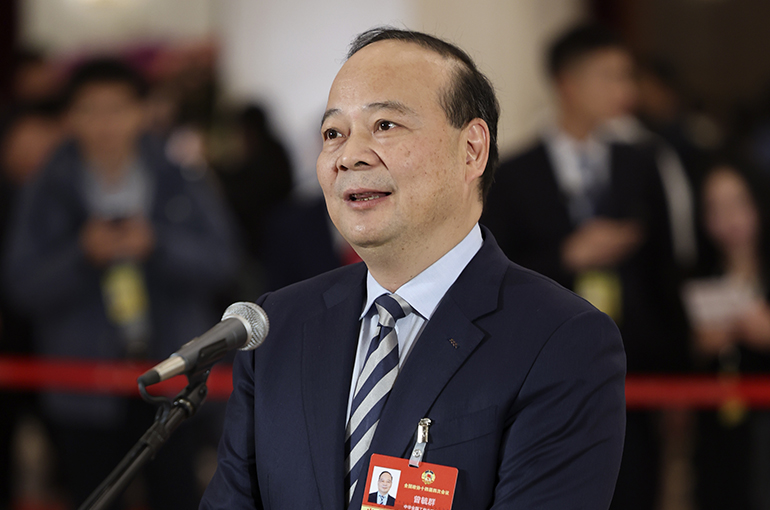
 CATL's Chairman, Other CPPCC Members Underline Need for Original Innovation
(Yicai) March 5 -- Scientific, industrial, and telecoms sector representatives attending this year’s Chinese People’s Political Consultative Conference, including the chairman of Contemporary Amperex Technology, have emphasized the need to pursue independent and original innovation as a central driver of technological progress and economic development.
"Critical core technologies cannot be obtained by asking or waiting for them," Pan Jianwei, a member of the CPPCC and the Chinese Academy of Sciences, said in a group interview yesterday following the Fourth Session of the 14th CPPCC National Committee.
Pan cited the example of the dilution refrigerator, a key piece of equipment for quantum computing, noting that exports of the devices to China were previously banned. His team independently developed a product at an internationally advanced level, supporting the development of the Zuchongzhi quantum processors.
"We must have confidence in ourselves, pursue independent innovation, and turn bottlenecks into springboards for development,” Pan pointed out.
Looking ahead to the 15th Five-Year Plan, which will run through 2030, Pan said his team will continue to beef up original innovation, promote deep integration of industry, academia, and research, and accelerate the commercialization of new products, so that quantum technology can better serve the cultivation of new quality productive forces and drive high-quality economic and social development.
CATL Chairman Zeng Yuqun likewise said that the priority is to persist in independent innovation. The Ningde-based battery giant has been investing more than CNY20 billion (USD2.9 billion) in research and development annually in recent years, with over 21,000 staff engaged in independent R&D, and it has amassed in excess of 50,000 patents, enabling its battery products to power more than 20 million vehicles in dozens of countries and regions, he noted.
Beyond product leadership, CATL is also highly advanced in technology and standards, and has built a strong and resilient supply chain and ecosystem, Zeng added.
Over the course of the 14th Five-Year Plan, China built the world's largest fifth-generation network, with its 5G base stations accounting for more than 60 percent of the global total, said Yang Jie, another CPPCC member and former chairman of mobile telecoms carrier China Mobile.
Over the next five years, the country should further advance the deep integration of scientific and technological innovation with industrial innovation, so that more scientific advances move from “the bookshelf to the store shelf,” according to Yang.
Proposals for the 15th Five-Year Plan explicitly called for strengthening original innovation and breakthroughs in critical core technologies, recommending the adoption of “extraordinary measures” to drive decisive, end-to-end breakthroughs in key fields such as integrated circuits.
“Extraordinary” does not mean acting blindly against scientific principles, but rather breaking free from path dependency and institutional barriers, building “innovation consortia” to shift from isolated breakthroughs to a full-chain systematic approach to core technologies, said Guo Yufeng, also a CPPCC member and deputy general manager of central processing unit maker Phytium Technology.
Guo said that regulatory oversight of technological innovation must be strengthened in parallel, so as not to undermine business confidence in deploying innovations at scale and to avoid triggering systemic risks.
Editor: Futura Costaglione