



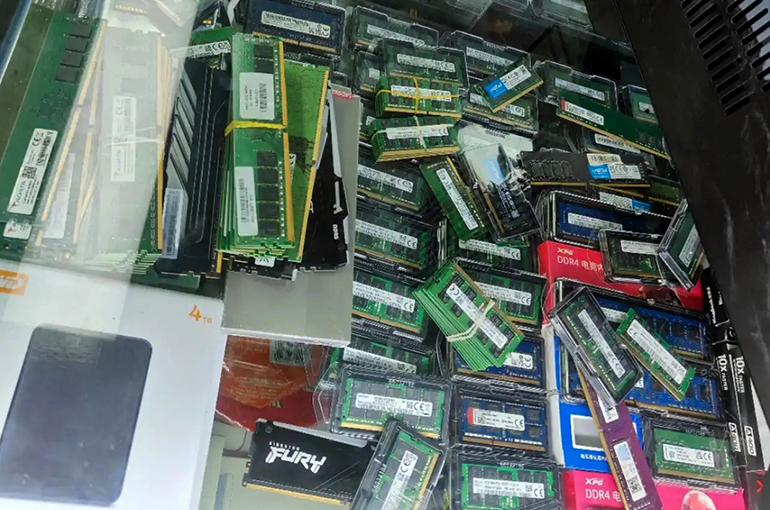
 Unexpected Spike in Memory Storage Costs Pushes Up Smartphone, Computer Prices in China
(Yicai) Dec. 3 -- Many newly released mobile phones in China are selling for between CNY100 (USD14) and CNY300 more than their previous models due to unforeseen hikes in the price of memory storage, and even bigger increases could be still to come, industry insiders said.
“I advise clients that if they want to buy a smart device, they should do so quickly. Prices are going to skyrocket and products will suddenly become very expensive. This is caused by the epic price increases in the memory storage sector,” said Ni Huangzhong, chairman of memory product maker Shenzhen Shichuangyi Electronics.
Most smartphone makers do not keep a large inventory of memory products, which means they have no choice but to accept the increasing prices if they want to keep producing, market research firm TrendForce told Yicai.
Wafers produced by NAND flash memory manufacturers are sold to third-party memory module makers who turn them into solid-state drives and embedded memory products used in mobile phones, computers, servers and other smart devices. Recently, these module makers have been struggling to secure enough wafers, leaving them short on stock.
“All production capacity was fully booked before last month. Orders for the next three years are already lined up. There is no capacity left for next year,” a representative from a NAND flash memory maker told Yicai at a recent exhibition.
“Our SSD production capacity is fully booked. We stopped accepting orders last month. Many other SSD module manufacturers have also paused giving quotations,” marketing directors at several NAND producers told Yicai.
Soaring Prices
In the spot market, the price of 1-TeraByte quad-level cells of NAND flash memory surged 78 percent on Nov. 25 from the beginning of the month to USD12.50, while that of 16-GigaByte Double-Data-Rate Fourth Generation Synchronous Dynamic Random Access Memory 3200 soared 50 percent to USD30, according to industry data. One module manufacturer said that before they stopped quoting in November, their SSD prices in October were already between 30 percent and 40 percent higher than in September.
“US tech firm SanDisk raised its prices in March and again in September. Everyone accepted the second round of price hikes, but by October it became clear that things were changing,” Ni said. “In November, Milpitas-based SanDisk said it was hiking prices by another 50 percent, and South Korea’s Samsung followed with price increases of over 60 percent on some products.”
Ni said that in his 10-plus years in the industry, price hikes were usually triggered by greater mobile phone capacity or abnormal situations at manufacturers such as power outages and fires. This time, however, the shortage is being caused by the large-scale adoption of artificial intelligence. It is structural and long-term and is far beyond anything anyone expected.
Unprecedented Cause
Because the cause is unprecedented, it is difficult for the industry to accurately predict the future. One thing NAND flash memory manufacturers are certain about, though, is that it will take at least two years for new production capacity to come online. “If we invest in new facilities now, it will take about two years for mass production to start,” the representative from the NAND producer said.
Samsung and South Korea's SK Hynix have plans to build new plants but construction will not be completed until the second half of 2027, Wu Yating, senior deputy general manager of research at TrendForce, told Yicai. Then it will take at least another half a year before production can begin. This means that production capacity is unlikely to increase much before the end of 2027.
“No matter how much manufacturers invest, with limited factory space, supply will not rise significantly next year,” Wu added.
No End in Sight
As for how long the price surge will last, Ni said he has met with many clients who are all asking the same question. He believes it will last for several years, although some think the cycle could last 10 years.
Dynamic Random Access Memory cards will see a gap of at least 6 percent in supply and demand and prices will surge 58 percent on average, Wu said.
“No one knows how high prices will rise but many believe the price hikes will last longer than the previous cycle of eight quarters,” the marketing director of a NAND flash memory module factory said. SSD shortages will soon be as severe as that of hard disk drives, and prices will definitely rise, although it is hard to predict by how much.
Editor: Kim Taylor





