



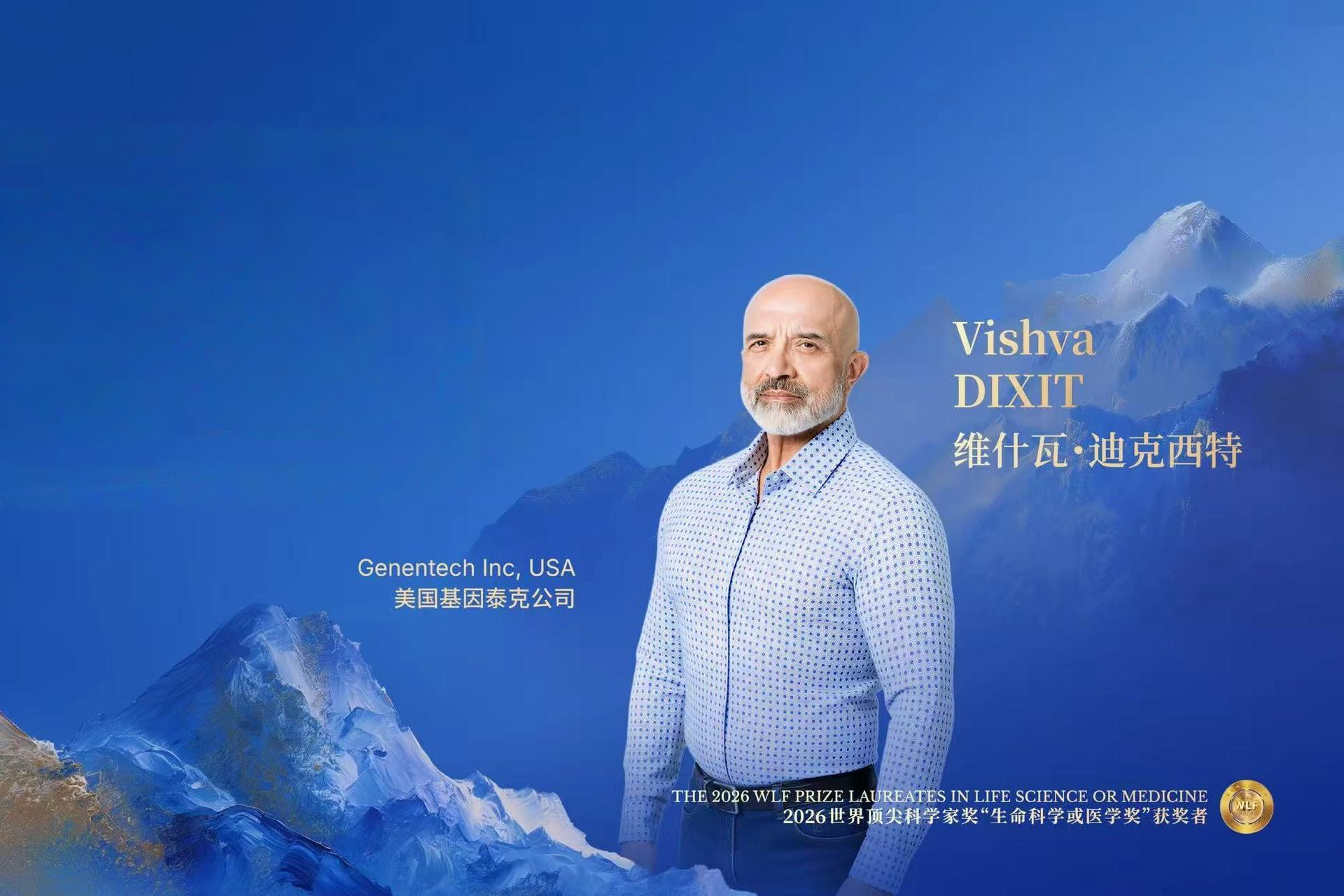
 Unveiling the "Molecular Scissors" and Life Switches of Cells: An Interview with 2026 WLF Prize Laureate in Life Science or Medicine Dr. Vishva DIXIT
(Yicai) Oct. 9 -- Background Introduction: In the grand landscape of biomedicine, deciphering how cells "actively choose to die" represents a profound revolution in understanding biological development and human disease. Dr. Vishva DIXIT has been awarded the 2026 World Laureates Foundation Prize in Life Science or Medicine for his historic contributions to the molecular mechanisms of cell death and inflammation. During his medical studies at the University of Nairobi, he resolved to devote himself to basic biomedical research. After moving to the US, Dr. DIXIT completed pathology training at Washington University in St. Louis and subsequently launched his research career at the University of Michigan, Ann Arbor and Genentech.
1. Sickness Transcends National Boundaries: Collaborate for Humanity
Q:How do you feel about receiving the 2026 WLF Prize in Life Science or Medicine?
Dr. Vishva DIXIT: I was very surprised and deeply honored to share this award with good friends and admired pioneers—WANG Xiaodong, YUAN Junying, and SHAO Feng.
My message to the global audience is that sickness transcends any national boundary. A sick person does not care where a medicine was discovered. We must work together as global collaborators for humanity.
2. “The Executioner is Like a Set of Molecular Scissors, Irreversibly Cutting Up Crucial Proteins”
Q:Your work played a historic role in revealing how cells actively choose to die. If you were to explain your discovery to a non-biologist using a simple everyday analogy, what kind of "internal shutdown switch" did you uncover to help the body clear out damaged cells?
Dr. Vishva DIXIT: Yeah, it's a great question. We live because we die in a sense that injured cells, mutant cells, old cells all have to die so that new cells, younger cells can replace them. But the question becomes then, how does a cell decide to die? And if it decides to die, what is the nature of the executioner? In the real world, if somebody is killed, we would ask, are they shot, were they stabbed? How did they die? And the process of cell death is important, not only for diseased cells and old cells and mutant cells, but also in development when we are being formed as embryos, it is involved in the sculpting of the human form so that orifices like your mouth are created by cells deciding to die.
So that raises a very important question: what is the arbitrator, who is the judge that says "you must die, you must live"? And then what is the nature of the executioner? Our work really illuminated that the executioner is a set of molecular scissors. It's like a scissors that cuts up the inside of a cell, cuts up crucial proteins, components of the cell. And because of this cutting, which is irreversible, once you cut, you can't rejoin, then the cell dies. But this executioner apparatus, these molecular scissors, are then governed by another structure, the arbitrators or judges—some are death receptors on the cell, in other cases molecules released from damaged mitochondria—and balanced by a whole family of molecules that inhibit cell death. Our study over the years has defined the executioners and how they are regulated by the inhibitors.
3. “The Biggest Bottleneck Was Overcoming Redundancy and Plasticity in Death Pathways”
Q: When cells get damaged, they need to safely clear themselves out like a bomb defusal team. But if this shutdown process gets out of control, it can trigger severe inflammation and autoimmune diseases. What was the most challenging bottleneck in mapping these molecular pathways, and how does your research help us stop this "friendly fire"?
Dr. Vishva DIXIT: I think the challenge was, to a certain extent, redundancy. By that, I mean if you block one death pathway, then another can take over. So there are many death pathways; you block one, another one takes over, and the cell still dies. And we had to do very complicated genetics to understand what you would think of as plasticity, that you inhibit something and another thing takes over, which made defining the components a challenge.
But now that the key components have been defined, we know the major players, it's an opportunity to pharmacologically manipulate them. So for the molecular scissors, for example, we could develop chemical inhibitors, opening up that possibility in drug development. So the bottleneck was overcoming this redundancy and mapping the pathways genetically.
4. “The Greatest Barrier in the 'Valley of Death' Is Safety Signals and Matching the Right Indication”
Q:You have spent decades at Genentech, one of the world's leading biotech companies. Many major scientific discoveries in the lab never make it into hospital medicine. As someone who understands both basic science and drug development, what is the hardest step in turning a fundamental biological discovery into a drug that saves real lives?
Dr. Vishva DIXIT: A very important component is patience. People don't realize how long it takes to go from a basic discovery to a drug. Everybody's excited about GLP-1 agonists, but work on them actually started in 1984. You have to be patient, focused, and persistent.
The valley of death in drug development is mostly safety signals. It is still very difficult to predict the safety of a medicine in humans, and many small molecules that work in animal models fail in humans because safety risks outweigh benefits. Another major reason drugs die is picking the wrong indication due to complex biology. Anti-TNF antibodies for inflammatory diseases—originally started off as a failure because they were developed for cancer. Matching the medicine to the right disease indication is critical.
5. “From BCL-2 Inhibitors in Leukemia to NLRP3 Targeted Therapies for Cardiovascular Disease”
Q:Which diseases do you think are now closest to benefiting from drugs that precisely manipulate cell-death or inflammatory pathways?
Dr. Vishva DIXIT: In cell death manipulation, the prime example is the BCL-2 inhibitor Venetoclax, used to treat chronic lymphocytic leukemia by overriding the death inhibitor BCL-2 in cancer cells that alter the life-death equilibrium to favor cell death.
In inflammation, the best example today is NLRP3 inhibitors. Phase 2 clinical trials by Eli Lilly and Nodthera in cardiovascular disease showed strong promise for patients with an inflammatory endotype marked by high C-reactive protein. If Phase 3 succeeds, it will change the complexion of cardiovascular treatment.
6. “The Question Should Not Be How Many Papers You Published, But What You Discovered”
Q:Biological experiments often involve repeated failures and uncertainty. What advice would you give to early-career researchers who spend months or even years on an experiment without getting the expected results?
Dr. Vishva DIXIT: Research is a difficult career because most of what you do fails. You have to be really passionate about it and driven by curiosity. Too often people are driven by getting a paper in Cell, Science, or Nature. I think the question should not be how many papers you have published, but what have you discovered?
If you are really passionate about research, understand that it's a long but very rewarding road, like being an explorer discovering things no one has seen before. Nature does not give up its secrets easily, so don't be attracted by just producing papers, but try to make a big discovery.
7. “Are We Alone in the Universe, or Is There Life Elsewhere?”
Q:As part of our "Science Relay," if you were to leave an open scientific guess or unsolved question for another award winner to answer, what would you ask them?
Dr. Vishva DIXIT: Now that we've discovered planets outside of our solar system and many galaxies, the question looms large whether there's life on those planets. With more sophisticated astrophysical instrumentation, the question I would put down is: Are we alone in the universe, or is there life elsewhere?
Prize Introduction
The World Laureates Foundation Prize (WLF Prize) is initiated and organized by the World Laureates Foundation, with exclusive prize funding donated by Sequoia China and support provided by Shanghai Lingang Science and Technology Innovation Development Foundation. The prize recognizes and supports outstanding researchers and technology pioneers worldwide for their contributions to science, selects and backs the world’s most promising young scholars, and creates a dual-award framework for dialogue, collaboration and joint development between top scientists and rising young scientific talents. It aims to advance global scientific and technological progress and inject new momentum into Shanghai’s efforts to build a world-class international science and innovation center with high quality.
The prize comprises three sub-awards: the World Laureates Foundation Prize in Computer Science or Mathematics (CSM), the World Laureates Foundation Prize in Life Science or Medicine (LSM), and the WLF Prize for Young Scientists.





