



 World’s Biggest Ice Cream Maker Goes Public After Unilever Spin-Off
(Yicai) Dec. 10 -- The Magnum Ice Cream Company, the world’s largest ice cream producer, has started trading on the Amsterdam, London, and New York stock markets after being hived off from UK consumer packaged goods giant Unilever.
Since debuting on Dec. 8, TMICC’s shares have fallen in London and New York, but risen in Amsterdam. The company issued 612 million shares, giving it a market capitalization of around EUR7.9 billion (USD9.2 billion).
The business was split off from Unilever last year and started operating independently as TMICC this July. Unilever still owns a 20 percent stake, which it plans to sell over the next five years.
Unilever determined that the business, which is highly seasonal, capital intensive, and dependent on cold chain logistics, no longer complemented its four core business groups and would perform better under standalone ownership, while the separation would leave Unilever more focused and better able to direct resources toward businesses with operating models that align with its strengths.
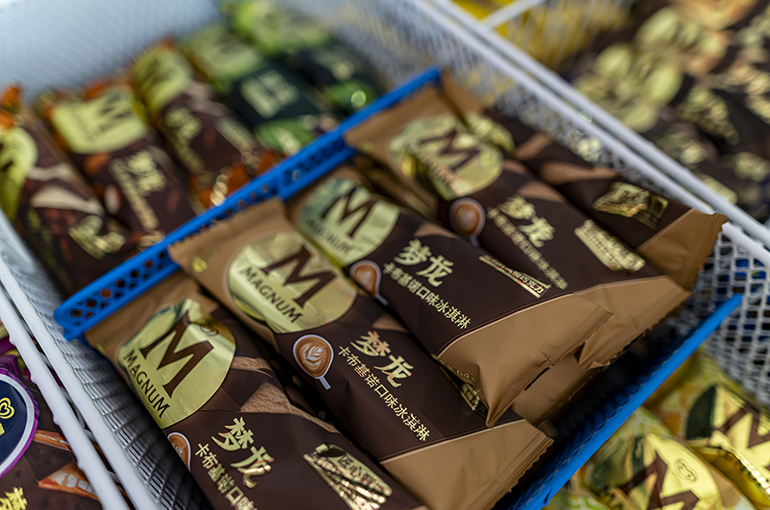
Amsterdam-based TMICC had revenue of EUR7.9 billion (USD9.2 billion) last year, accounting for 21 percent of the global market, according to its listing prospectus. China is one of its top 10 markets worldwide, but is the only one where TMICC -- whose brands include Cornetto, Magnum, Wall's, and Viennetta -- ranked second last year with an 11 percent market share.
Cornetto was fifth and Magnum seventh among the top 10 ice cream brands in China in the 12 months ended Nov. 30, with Inner Mongolia Yili Industrial Group and China Mengniu Dairy owning the other eight, according to the latest data from offline retail monitoring network Brandct.com.
The Chinese market for ice cream has seen growth slow. The average price per hundred grams of ice cream stood at CNY3.65 (52 US cents) over the first 11 months of this year, compared with CNY3.94 in 2023, according to Brandct.com.
"As a foreign brand, TMICC has a relatively high overall gross profit margin," noted Zhu Danpeng, a Chinese food industry analyst. “Relying on its brand, scale, and fan effect, as well as the completeness of its supply chain, its advantages will remain after going solo, with the firm being more focused, while resources will be more concentrated.”
"The key question is when TMICC's product pyramid will be established," Zhu said.
Editor: Martin Kadiev





