 Zelos, Trina Solar Lead Wave of Chinese Firms Expanding Local Footprint in Dubai
(Yicai) Jan. 30 -- An increasing number of Chinese companies, from unmanned logistics vehicle unicorn Zelos Technology to photovoltaic giant Trina Solar, are establishing a presence in Dubai, United Arab Emirates. By partnering closely with local firms or by setting up regional headquarters, they are able to strengthen operations on the ground.
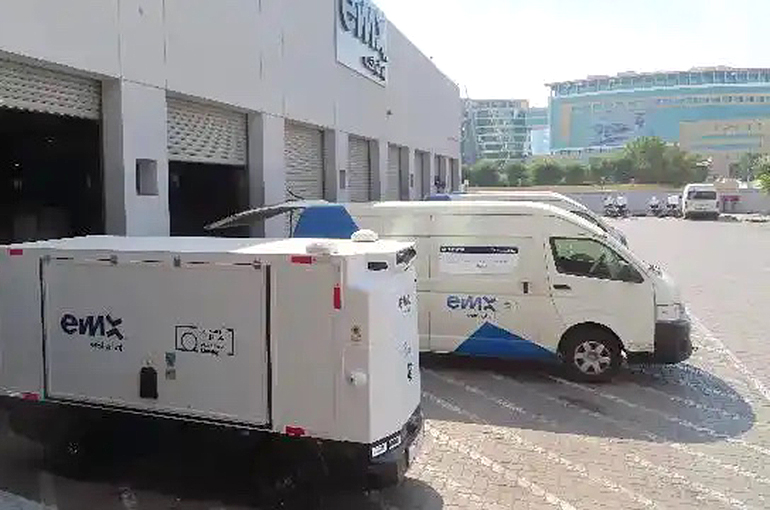
Suzhou-based Zelos is teaming up with the UAE’s national postal company 7X to tackle the last-mile delivery challenge. Together, they plan to roll out L4-level RoboVans from Dubai to the entire Middle East region, said Wang Yongbo, the head of Zelos’ Middle East operations.
Their RoboVan joint venture, AutoLogiX, will start by handling deliveries within industrial parks and warehouses before expanding to long-haul routes between logistics centers, Wang said. A big advantage of RoboVans is that they can operate at night, freeing up valuable daytime road space, he added.
Zelos is also localizing its technology to handle desert conditions and rough roads. For example, it is upgrading the RoboVans’ sensors and battery systems to resist high heat and dust, boosting logistics efficiency.
Currently, the UAE does not allow RoboVans on the roads. To address this, Zelos and 7X are working with the Dubai Roads and Transport Authority to draft regulations, drawing on Singapore’s experience, Wang said.
Meanwhile, Trina Solar has chosen to expand into the local market by setting up regional headquarters. The Changzhou-based firm’s Middle East and Africa regional headquarters is located in the Dubai Multi Commodities Center, a free-trade zone with special incentives.
Trina Solar chose Dubai due to the city’s strategic location and green energy initiatives, Liu Guoguo, the firm’s marketing director for the Middle East and Africa, told Yicai. Dubai’s well-developed airport and port infrastructure make it easier to sell and re-export the company’s solar panels, she added.
China is the UAE’s largest trading partner and this relationship has seen rapid growth in recent years. The number of Chinese companies establishing a presence in the Dubai Multi Commodities Center has maintained double-digit growth for five straight years, the center’s Chief Executive Officer Ahmed Bin Sulayem said.
There are more than 40 free trade zones in the UAE, with Dubai accounting for over half. In addition to comprehensive zones like the Dubai Multi Commodities Center, there are sector-specific zones such as Dubai Internet City, which is located next to the Dubai Multi Commodities Center and which has attracted a number of Chinese tech giants including ByteDance, Huawei Technologies and Alibaba Group Holding.
After setting up regional headquarters in the area, Chinese tech firms not only provide existing services, but they also launch innovation centers dedicated to developing products tailored for the Middle East region, said Ammar Al Malik, managing director of Dubai Internet City.
Editors: Dou Shicong, Kim Taylor