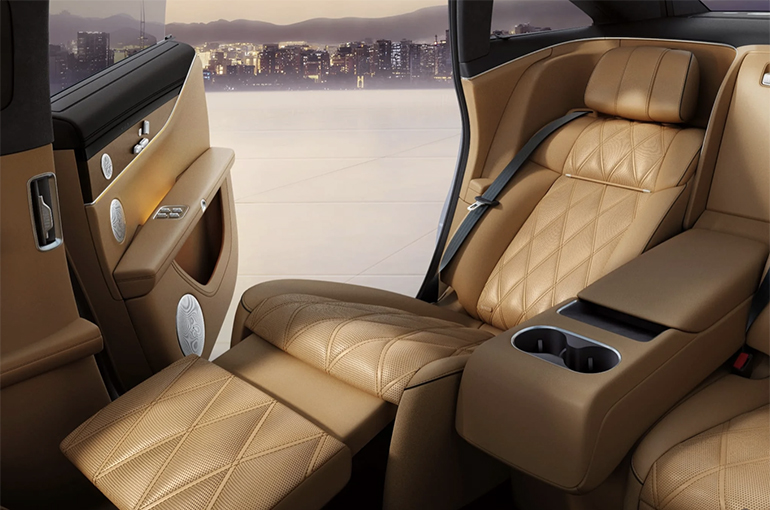
 Zero-Gravity Seat Boom in China’s Auto Market Sparks Safety Debate
(Yicai) May 8 -- Zero-gravity seats, which are designed to create a sensation of weightlessness and enhanced comfort, are quickly becoming a mainstream feature in China’s vehicle market, but their potential safety risks have raised widespread public concern.
Zero-gravity seats, which come with functions such as massage, heating and ventilation, are being used by car manufacturers as a key selling point to attract customers. Despite costing around 30 percent more than ordinary seats, they are being widely adopted in the market.
The number of car models equipped with zero-gravity seats in China surged almost 2.7 times to 117 in 2024 from 32 in 2022, according to data from the China Automotive Engineering Research Institute. Overall penetration has surpassed 5 percent, and the feature has quickly moved from luxury vehicles priced above CNY300,000 (USD44,104) to mainstream models under CNY200,000.
Crash safety, though, is a big issue. “The risk of injury increases significantly in collisions using zero-gravity seats,” said Zhao Hui, chief expert at the China Automotive Engineering Research Institute’s automotive index division.
“AIS3 (severe injuries) and AIS4 (critical injuries) accounted for over 70 percent of the injury values in crash scenarios, mostly affecting the chest and lumbar vertebrae," he said. "Zero-gravity seats were mainly developed around comfort and smart cabin features, but little consideration was given to their safety performance.”
Test data from German passive safety system solution provider ZF LIFETEC show that when a vehicle collides at a speed of 50 kilometers per hour, the spinal injury to a person in a fully reclined zero-gravity seat is comparable to jumping from a five-story building.
There are also risks of accidental pinching during seat folding. Several researchers from auto firms told Yicai that the folding action of zero-gravity seats involves the co-ordinated movement of rails, backrests, and leg rests, making it difficult to set a fixed anti-pinch threshold. As a result, the risk of accidental pinching has not been fully eliminated.
China is working to address these issues through updated regulations. The national standard GB15083, which covers strength requirements and testing methods for automotive seats, seat anchorages and headrests, is under revision and should be completed by the end of this year.
The revisions are expected to clarify maximum recline angles for zero-gravity seats during driving, to require integrated seat belts or dedicated restraint systems and to mandate clear safety instructions from manufacturers.
Several automakers interviewed by reporters have stated that they do not recommend using zero-gravity seats while the vehicle is in motion.
Editor: Kim Taylor