



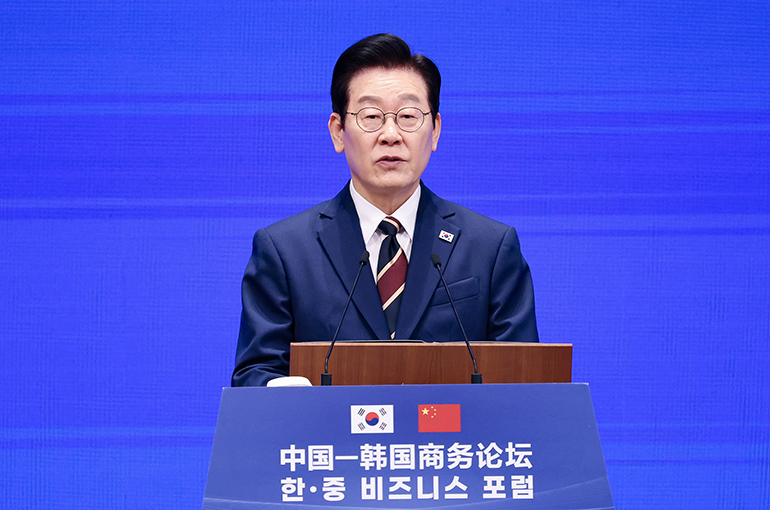
 Lee’s China Visit Brings Big Group of Korean Business Leaders Amid Trade Deficit
(Yicai) Jan. 5 -- The large delegation of South Korean business leaders accompanying President Lee Jae-myung on his state visit to China this week reflects a push by Korean firms to find new markets and opportunities in the country amid a trade deficit with China, according to a scholar.
South Korea’s trade surplus with China turned into a deficit in 2023, signaling a break from the long-standing pattern in which Korea supplied high-end intermediate goods, while products processed and manufactured in China were exported to the rest of the world, Huang Fei, a professor at the Seoul School of Integrated Sciences and Technologies, told Yicai.
The country ran a trade surplus with China of USD28.97 billion in 2019, but that had turned into a deficit of USD6.83 billion in 2024, and last year marked the third consecutive annual deficit, according to Korean customs data.
Against this backdrop, over 200 Korean business leaders, including the heads of Samsung Electronics, SK Group, Hyundai Motor, and LG Group, are visiting China along with Lee, more than twice the number of a similar group in 2019.
China has achieved large-scale domestic substitution in areas such as semiconductors, display panels, chemical materials, and general components, Huang said, adding that its dependence on imports from South Korea has fallen significantly.
At the same time, China’s share of processing exports to Europe and the United States has declined, with export focus shifting more toward Southeast Asia and developing countries to China’s south, weakening South Korea’s role as a key supplier of components, she said.
South Korean exports are highly concentrated in chips, displays, and chemical products, so when these industries simultaneously face a cyclical downturn, technological substitution, and geopolitical pressures, a trade deficit will rapidly appear, Huang said.
Bilateral trade is unlikely to return to the old vertical division of labor and will instead move toward a new pattern of “limited competition and functional complementarity,” Huang noted. Fields such as new energy, green technologies, eldercare, and digital services trade may become the next growth points for cooperation, with these demand-symmetric sectors expected to act as stabilizers for economic and trade ties, she said.
The biggest risk facing China-South Korea economic relations is not competition itself, but irrational decoupling driven by misjudgments or abrupt policy shifts, Huang pointed out.
“Clarifying policy bottom lines in sensitive areas such as semiconductors, new energy, and core materials through high-level dialogue would provide firms with a minimum stable expectation and prevent investment and supply chain decisions from being stuck in long-term limbo,” she added.
Editor: Emmi Laine





