



 Android Breakout Moment Could Take Two to 10 Years, Boao Forum Experts Predict
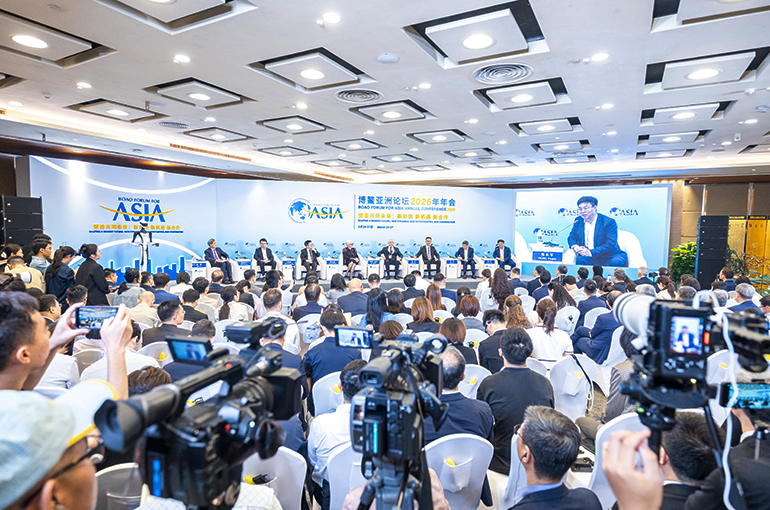
(Yicai) March 26 -- Industry experts at the ongoing Boao Forum for Asia are debating when humanoid robots will reach their “ChatGPT moment,” with estimates ranging from as soon as two years to as long as a decade.
The term refers to the point when humanoid robots can reliably execute human instructions in unfamiliar environments, according to Chen Jianyu, founder of embodied artificial intelligence and humanoid robot developer Robot Era. Achieving this milestone would pave the way for large-scale commercial deployment of humanoid robots, he said.
Chen expects meaningful progress within five to 10 years, noting that current limitations stem from insufficient model generalization, which makes it difficult for robots to perform consistently across different environments.
Wang Xiaogang, co-founder of SenseTime and chairman of Ace Robotics, expressed a more optimistic outlook, saying the robotics sector could reach this inflection point once the total volume of robot interaction data reaches hundreds of millions of hours.
The industry has so far accumulated about 100,000 hours of interaction data, Wang said. With new data collection approaches being explored by SenseTime, the total could reach 10 million hours by 2027 and then quickly scale to hundreds of millions of hours. He added that this target could potentially be achieved within two years.
By contrast, Shao Hao, chief scientist at the robotics laboratory of Chinese smartphone maker Vivo, said the breakthrough could still be about 10 years away.
“From the rise of deep learning in 2012 to the explosion of ChatGPT in 2022, it took a decade,” Shao said. He added that ChatGPT’s success was largely due to the discovery of a low-cost pathway to acquire massive amounts of data, while the robotics industry still needs time to build a similarly cost-efficient large-scale data acquisition system.
Industrial Uses Likely to Precede Household Adoption
Despite the differing views on timing, speakers agreed that humanoid robots can continue expanding their presence in industrial and other specialized applications even before such a breakthrough occurs.
Industrial scenarios are highly standardized vertically, Chen said, adding that with sufficient data and computing power applied to existing models, robots can already be trained to perform certain key tasks. These capabilities could then be standardized and replicated across tens of thousands or even hundreds of thousands of similar roles.
Shen Dou, executive vice president of Baidu and president of Baidu AI Cloud Group, said household deployment may represent the “final step” for embodied intelligence applications because of the high capability requirements and the complexity of large-scale integration into home environments. Whether this can be achieved within the next decade remains uncertain, he noted.
By comparison, industrial and hazardous work environments, which are more standardized, are better suited for the early adoption of humanoid robots, Shen added.
Editors: Tang Shihua, Emmi Laine





