



 Chery Joins China EV Battery Race With Solid-State Tech Planned for 2027
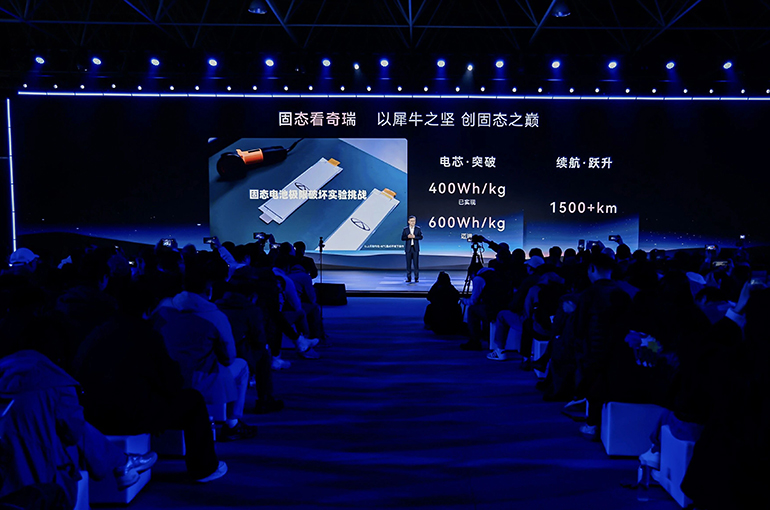
(Yicai) March 19 -- Chery Automobile, China's top passenger car exporter, unveiled a new solid-state battery with an energy density of up to 600 watt-hour per kilogram under its Rhino battery brand, with the technology expected to begin vehicle validation this year and achieve large-scale commercialization in 2027.
The battery, codenamed Rhino S, is designed to deliver a driving range of more than 1,500 kilometers, the Wuhu-based owner of brands Exeed and Jetour said yesterday. The battery uses sulfide electrolytes and a lithium metal anode and can maintain stable performance in temperatures as low as -30 degrees Celsius.
The announcement comes as Chinese automakers accelerate the development of solid-state batteries, which are widely viewed as a key next-generation electric vehicle technology despite commercialization challenges.
On the same day, Chery also released its financial report showing revenue rose 11 percent to CNY300.3 billion (USD43.5 billion) last year, while net profit jumped 36 percent to CNY19.5 billion (USD2.8 billion).
Looking ahead, Chery plans to expand investment in battery research and related energy infrastructure, including building a smart energy ecosystem and expanding its charging network.
Rhino Battery Product Details
Chery also introduced a liquid-electrolyte battery series under the Rhino brand capable of 1,200-kilowatt ultra-fast charging, enabling vehicles to gain a range of 500 kilometers after eight minutes of charging. The battery has a cycle life of up to 5,000 charge cycles and has passed safety tests, including puncture and penetration tests.
Gu Chunshan, vice president of Chery, said the company’s dedicated solid-state battery research team will exceed 1,200 people within two years, with more than 90 percent holding master’s or doctoral degrees. Total investment in specialized research and development is expected to exceed CNY10 billion.
Chery plans to build advanced laboratories, pilot production lines, and an integrated industrial ecosystem to support development. “There is no upper limit set for the R&D of solid-state batteries,” Gu said.
At the launch event, Chairman Yin Tongyue also said the carmaker plans to invest in controlled nuclear fusion technology and build a six-in-one smart energy system integrating vehicle, energy storage, charging, grid, cloud, and carbon management. Chery aims to build more than 20,000 charging facilities supporting vehicle-to-grid functions by 2029.
Chery’s new energy vehicle sales reached 826,500 units last year, up almost 73 percent from a year earlier. Overseas revenue accounted for more than 52 percent of total revenue, and the company has ranked first among Chinese passenger car exporters for 23 consecutive years.
China Automakers Accelerate Solid-State Battery Development
Other Chinese automakers are also advancing solid-state battery development.
For example, SAIC Motor plans to begin prototype vehicle testing this year and aims to achieve commercial mass production by 2027. BYD plans to begin small-scale demonstration use of sulfide-based solid-state batteries in 2027, initially installing them in about 1,000 vehicles under its luxury EV brand Yangwang, before expanding to about 40,000 vehicles by 2030 and extending the technology to its premium Dynasty and youthful Ocean series.
Moreover, battery giant Contemporary Amperex Technology expects to begin small-scale production of solid-state batteries by 2027, with large-scale commercialization likely after 2030.
Industry analysts noted that large-scale production of solid-state batteries still faces major hurdles, including manufacturing processes, cost control, and long-term reliability, with the key window for breakthroughs likely to come after 2030.
Editor: Emmi Laine





