



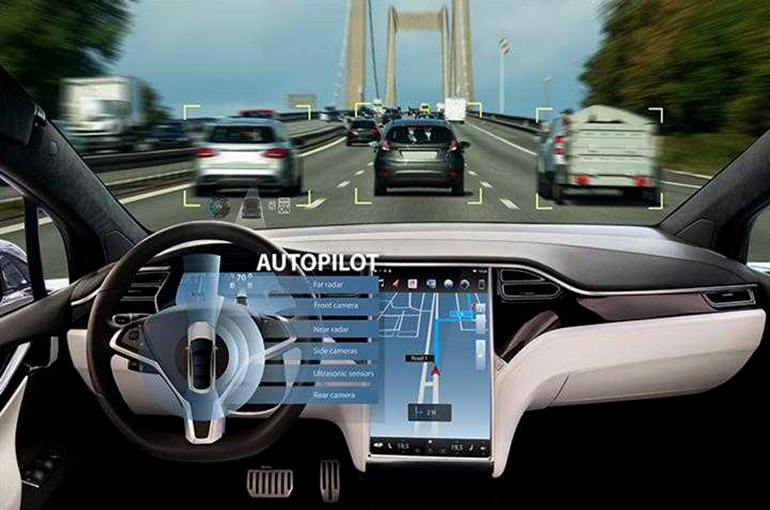
 China Grants First Open Road Permits to Two L3 Self-Driving EVs
(Yicai) Dec. 16 -- China has cleared two Level-3 autonomous driving passenger car models for conditional operation on public roads in Beijing and Chongqing in a landmark shift from test licensing to real-world use.
The two electric sedans -- Changan Automobile's Deepal SL03 and BAIC BluePark New Energy Technology's Arcfox Alpha S -- can use their L3 self-driving functions in congested traffic conditions without changing lanes on highways and urban expressways in Beijing and Chongqing, the Ministry of Industry and Information Technology announced yesterday.
“There were no L3 self-driving vehicles that could be mass-produced, sold, and operated on public roads in the market before the MIIT granted the new permits,” a BAIC BluePark official told Yicai. “The previous so-called 'L3 licenses' were actually trial permits, which only allowed testing on designated roads.
The new permit marks a “shift from 'approved for practice' to 'approved for roads,’" the person pointed out. “We’re now in the pilot phase for smart connected vehicles operating on public roads, with the Arcfox Alpha S planned to start running on the Beijing Daxing Airport Expressway in the first quarter of next year.”
The Deepal SL03 is equipped with Changan Auto's self-developed Tianshu Intelligent advanced driver-assistance system, while the Arcfox Alpha S has Huawei's Qiankun Intelligent Driving.
L3 autonomous driving means a vehicle can handle all driving tasks in certain conditions without continuous driver supervision, although a human must remain ready to intervene when the system asks.
The Deepal SL03 is now permitted to travel at speeds of up to 50 kilometers per hour in L3 self-driving mode, while for the Arcfox Alpha S that limit is 80 km/h, the MIIT noted. Both models have passed product testing and safety evaluations, as required by the ministry.
A Changan Auto official told Yicai that during the open road pilot, the Deepal SL03’s L3 function will only be used on government-approved highways and expressways to ensure safe and compliant operation. As policy evolves, the operational scope will be expanded through over-the-air updates.
China's self-driving vehicle sector is moving quickly from technology validation to mass production and large-scale use, Fu Bingfeng, executive vice president and secretary-general of the China Association of Automobile Manufacturers, told Yicai. The MIIT will continue processing applications and issuing permits as products mature, following a “permit when mature” principle, Fu added.
Carmakers should take this opportunity to actively assume their primary responsibilities, Fu noted. "First, they must strictly uphold the safety bottom line, continually improve technical maturity and enhance safety verification during the access and road operation pilot for smart-connected vehicles.
"Second, they should strengthen data governance, establish and improve data security and cybersecurity management systems, and ensure data traceability and risk control," Fu added. "And third, on the premise of ensuring safety, they should actively explore sustainable business models to accumulate valuable experience for the subsequent large-scale promotion and application."
Editors: Tang Shihua, Martin Kadiev





