



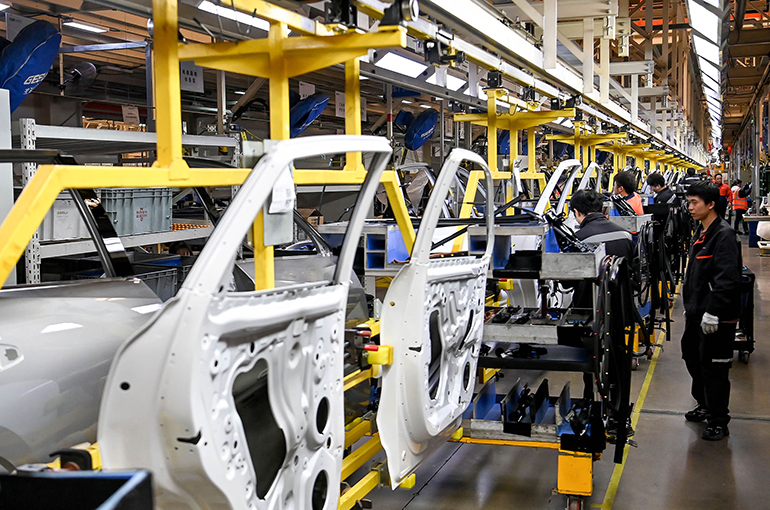
 China's Factory Activity Drops for Eighth Straight Month Despite Small Uptick
(Yicai) Dec. 1 -- Activity in China's manufacturing sector showed a slight improvement in November despite contracting for the eighth consecutive month, thanks to the positive results of economic and trade negotiations between China and the United States.
The manufacturing purchasing managers' index came in at 49.2 last month, up from 49 the month before, according to data released by the National Bureau of Statistics yesterday. A reading below 50 indicates contraction.
The PMI fell into contraction territory in April amid an escalation in China-US trade tensions. It was 49 in April, 49.5 in May, 49.7 in June, 49.3 in July, and 49.4 in August, and 49.8 in September.
At the end of October, economic and trade teams from China and the US held consultations in Kuala Lumpur, Malaysia, and reached an agreement to extend the suspension of reciprocal tariffs. As a result, China's new export orders index rebounded to 47.6 in November from 45.9 in October.
The overall manufacturing demand also recovered, with the new orders sub-index improving to 49.2 from 48.8, and the production sub-index rebounding to 50 from 49.7 in the period. Meanwhile, manufacturers' confidence was lifted, with the production and operation activity expectation sub-index rising to 53.1 from 52.8.
With the release of the Recommendations of the Central Committee of the Communist Party of China for Formulating the 15th Five-Year Plan for National Economic and Social Development, market confidence improved, said Zhang Liqun, a special analyst at the China Federation of Logistics and Purchasing. However, the manufacturing PMI remained below 50, indicating a market-guided demand contraction and downward pressure on the economy.
At the beginning of the 15th Five-Year Plan (2026-2030), China should further strengthen the counter-cyclical adjustment of macroeconomic policies and increase the scale of investment in government goods and services, effectively boosting business orders and reversing the market-guided demand contraction trend, Zhang suggested.
The non-manufacturing PMI, which includes construction and services, fell to 49.5 in November from 50.1 the previous month, dropping into contraction territory for the first time since January 2023, according to the NBS. Business activity in the construction industry rose to 49.6 from 49.1, while that for services plunged to 49.5 from 50.2.
As the National Day holiday set a high base in October, the service sector showed an off-season decline, which was the main factor leading to the slowdown in related non-manufacturing business activities in November, said He Hui, vice president of the CFLP.
With the upcoming year-end festivals and increased consumption demand in the winter season, the prosperity of the service sector is expected to pick up in December, He added.
The composite PMI output index, which combines the manufacturing PMI's production sub-index and the non-manufacturing PMI, fell to 49.7 in November from 50 in October, also swinging into contraction territory for the first time since January 2023.
Editors: Dou Shicong, Futura Costaglione





