



 Chinese Scientists Create Wearable Robot for Treating Muscular Atrophy in Kids
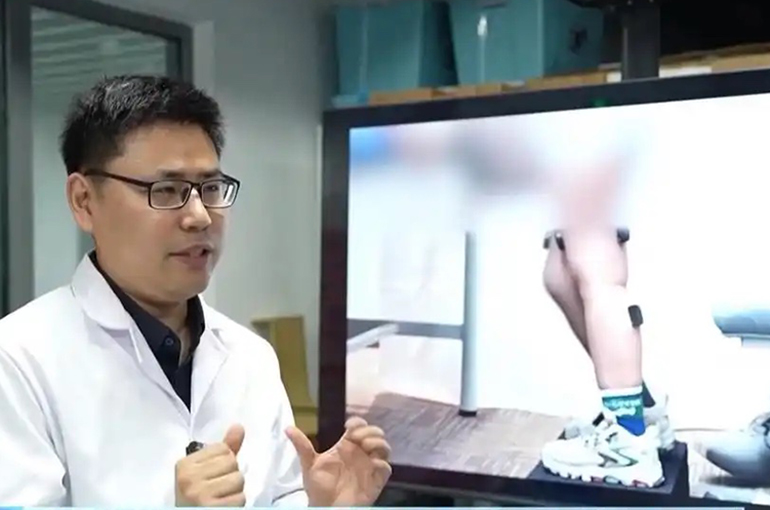
(Yicai) May 21 -- Chinese scientists have developed a wearable rehabilitation robot that can help children with severe muscular atrophy to regenerate muscle tissue through physical training.
Weighing less than 1 kilogram, the device was developed by a team led by Associate Professor Feng Yanggang from the School of Mechanical Engineering and Automation at Beihang University, in collaboration with partners from the Massachusetts Institute of Technology and Peking University Third Hospital.
The isokinetic robot attaches to the child’s knee, and clinical trials have shown that it can help kids with spinal muscular atrophy rebuild muscle function, according to a study published yesterday in the science journal Nature.
SMA is a hereditary neuromuscular disorder that is fatal in infants, and leads to progressive loss of motor function and carries the risk of death from respiratory failure due to paralysis of the breathing muscles when it occurs from childhood to adolescence. Existing drugs and therapies can slow the disease’s progression but cannot reverse it.
Unlike traditional rehabilitation robots that assist patients by providing support, Feng’s team adopted the opposite approach to help children with SMA to rebuild motor function. The device precisely applies resistance to increase movement difficulty, thereby stimulating the child’s nerves and muscles to achieve therapeutic effects.
The research team recruited six children with SMA aged six to 10 and conducted five-and-a-half-month clinical trials. After resistance training with the help of the robot, the children demonstrated significant improvement in lower-limb motor function, with coordinated growth in both muscle and nervous systems.
Moreover, the rehabilitation effects were maintained even after the children stopped using the robot and returned to daily life, the study showed.
Compared with traditional intervention methods that merely maintain existing muscle levels, isokinetic resistance training can significantly enhance muscle strength and promote substantial muscle growth, providing new scientific evidence for precise rehabilitation in neuromuscular disorders, the development team said.
Editor: Tom Litting





