


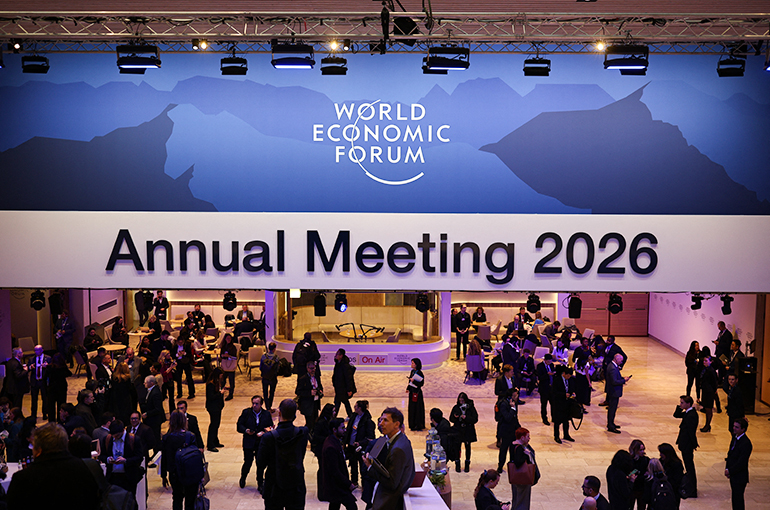
 Europe's Over-Specialization 'Killed the Ecosystem', The Bridge Tank's Chairman Says At Davos Special Meeting
(Yicai) Jan. 22 -- China's strategy of maintaining all industrial segments offers critical advantages in a fragmented world, while Europe's over-specialization "killed the ecosystem," according to the chairman of dialogue platform The Bridge Talk.
"In Europe, we've done one thing which has killed the ecosystem," Joël Ruet said yesterday at the Tencent Finance World Economic Forum Vision Dinner, which had Yicai Global as media partner in Davos, Switzerland.
"We believed maybe too much in the Chicago textbook economics about optimization, about the specializing in some segments of the value chain instead of keeping some industries alive," he noted. "We've not thought that those old industries could have given birth to new industries."
Meanwhile, Ruet explained that China kept all segments of the industry. "This is what we need," he believes. Geographies need as many industries and segments as possible to enable systemic innovation, which involves progress across all sectors thanks to a recombination of capabilities rather than following predetermined plans.
Ruet also used the term' industrial options,' which allows breadth across manufacturing sectors, so that investment in one industry enables development in another. This matters because global supply chains have fundamentally shifted character. Before, efficiency was prioritized through specialization and just-in-time logistics, but now, the focus is on resilience through redundancy and optionality.
When a shock hits, whether it is a pandemic, sanctions, or technological disruption, economies with diverse industrial bases can pivot and recombine existing capabilities. But specialized economies cannot.
This framework helps explain divergent outcomes in technology transitions. Countries that maintained 'unproductive' industrial segments suddenly found them essential when electric vehicles, renewable energy, and advanced manufacturing required capabilities that highly optimized economies had discarded.
For policymakers, this implication challenges conventional wisdom about comparative advantages and specialization gains. In a world requiring multiple scenarios and rapid recombination, maintaining seemingly redundant industrial capacity is not a waste but a strategic insurance. The question is not which industries a country should specialize in, but which industrial options it cannot afford to lose.
Editor: Futura Costaglione