



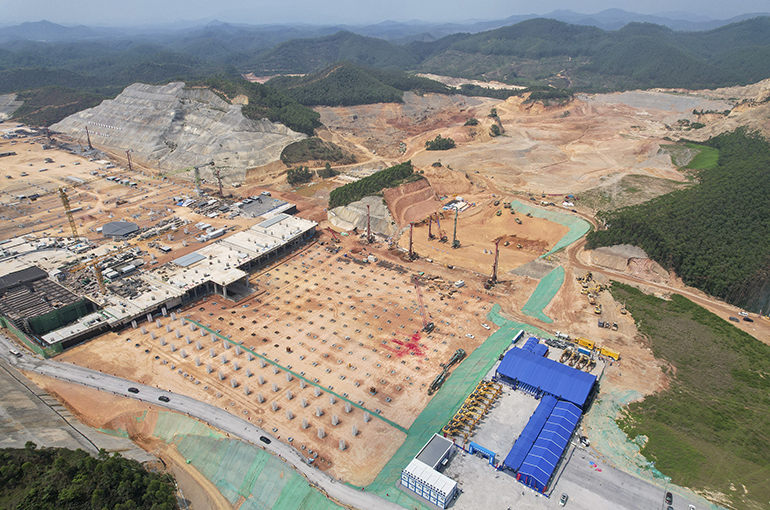
 China’s Foshan Breaks Ground on Greater Bay Area’s Sixth Major Airport
(Yicai) March 26 -- Work has got underway in the Chinese city of Foshan to build the sixth major airport serving the Guangdong-Hong Kong-Macao Greater Bay Area at a cost of CNY41.8 billion (USD6.1 billion).
The Pearl River Delta Hub Guangzhou New Airport broke ground yesterday in the Gaoming district of Foshan, which neighbours Guangzhou, the capital of China’s southern Guangdong province.
The first phase of the new airpot, which will have two runways and one terminal building, is designed to handle annual passenger throughput of 30 million and cargo throughput of 500,000 tons. After expansion, that will reach 60 million passengers and 2.2 million tons of cargo by 2050.
Guangzhou Baiyun International Airport, the only airport in operation in Guangzhou, handled 83.6 million passengers and 2.44 million tons of cargo last year.
Once up and running, the new airport will serve regional travel demand by fill the gap in civil aviation infrastructure on the western side of the Pearl River estuary. It will also combine with the Greater Bay Area’s existing major airports to create a more balanced, wider-reaching, world-class aviation network.
The Greater Bay Area, a key national project, is a megalopolis that comprises nine cities in Guangdong and the neighbouring special administrative regions of Hong Kong and Macao.
The Greater Bay Area has five existing airports with annual passenger throughput of over 10 million each within a radius of less than 200 kilometers. They are Guangzhou Baiyun International Airport, Hong Kong International Airport, Shenzhen Bao'an International Airport, Zhuhai Jinwan Airport, and Macao International Airport. Each is undergoing expansion.
These airports operate under different authorities, making coordinated planning difficult, Wang Ping, a civil aviation industry insider, told Yicai about potential excessive competition between the region’s densely clustered aviation hubs.
Higher-level coordination may be needed to allocate traffic rights and routes, making sure the airports do different things instead of all trying to do the same thing, so they work better together instead of competing inefficiently, he added.
Wang also suggested encouraging cross-shareholding among the airports to establish a cooperation mechanism based on capital ties. Such arrangements could strengthen coordination in airspace allocation, route network planning, and the assignment of traffic rights and slots, he said.
Editors: Tang Shihua, Futura Costaglione





