



 Tech Leaders, Experts Highlight Importance of Adaptability Amid Fragmentation at Special Meeting in Davos
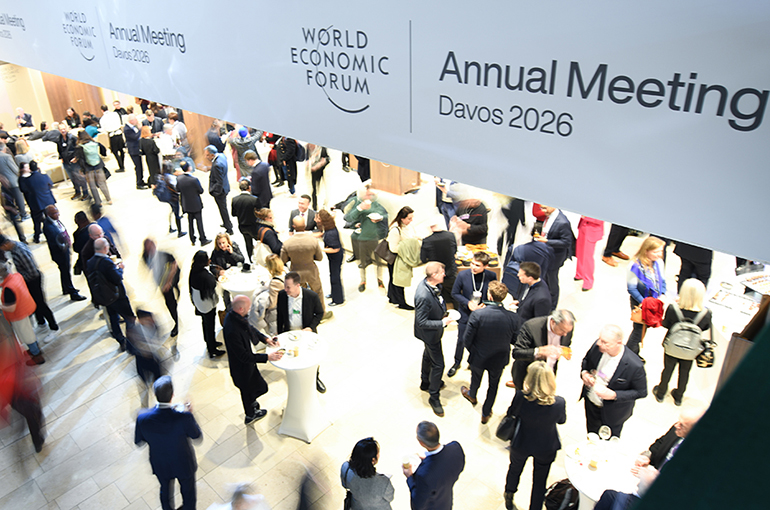
(Yicai) Jan. 22 -- Global tech leaders and experts emphasized the importance of adapting strategies to grasp opportunities in this era of fragmentation at a special meeting during the World Economic Forum in Davos, Switzerland.
"The interesting thing is that nobody can agree with anything on artificial intelligence," Dowson Tong, Tencent Holdings' senior executive vice president, said at the Vision Dinner yesterday. “What makes humans different is the personal interactions, having different opinions, and we can still work together and collaborate from different perspectives with different skills.”
The meeting, titled Tencent Finance WEF Vision Dinner 2026, was hosted by Chinese internet giant Tencent and had Yicai Global as media partner.
Global collaboration is not declining but transforming, according to Gim Huay Neo, managing director and China chair at the WEF Managing Board. "Instead of multilateralism, you actually now have this new word called minilateralism," she said, explaining that it refers to like-minded countries forming smaller coalitions.
"The whole idea of minilateralism is prosperously a reality of a very fragmented world," Neo noted. She emphasized that these groups should work toward common goals, such as promoting business opportunities, more trade, and more investment, rather than narrow interests.
Adaptability depends more and more on industrial depth rather than optimization. Global supply chains have shifted from an optimization-focused era to one requiring multiple options and scenarios, according to Joël Ruet, chairman of dialogue platform The Bridge Tank.
"In China, we have all segments of industry, and this is what we need," Ruet said, opposing it with Europe's over-specialization approach that has "killed the ecosystem." The principle of industrial options means maintaining breadth across sectors, so that one industry's development can enable the next, creating a systemic innovation rather than sequential planning.
When recombination becomes necessary, whether due to technological disruption or geopolitical pressure, having preserved multiple industrial segments provides strategic flexibility that specialized economies lack. Ruet argued that this explains why certain geographies can pivot to emerging technologies while others cannot, despite comparable financial resources.
Sector-specific adaptations reflect broader shifts. Vertical AI models tailored to certain domains, such as education, prove more effective than general large language models that answer without fostering learning capabilities, said Jolene Liang, co-founder of education technology firm Squirrel AI Learning.
The United States is a "pretty disruptive force at the moment," but only accounts for 25 percent of the global gross domestic product, Michael Spence, 2001 Nobel laureate in economics, said regarding the deglobalization concerns. The other 75 percent, which includes Europe, China, and other major emerging economies, is operating under an evolving multilateral system, he noted.
"Trade is not falling off," he added. “The notion that this thing is sort of collapsing is just probably wrong.”
Spence highlighted how inclusive growth patterns enabled by technology are spreading globally. “The digitally enabled payment system, the digitally enabled credit systems, the use of AI to deliver expanded services to remote populations is something that preceded first in China and is now being imitated all over the world.”
AI's first major impacts will appear in biomedical science, he said, using AlphaFold's protein folding technology, which is used by three million researchers across 190 countries, as an example.
On broader economic impacts, Spence cautioned against premature predictions, claiming that institutions are still determining optimal uses and that the technology changes every three months.
During the 15th Five-Year Plan period (2026-2030), China will shift its focus to encompassing green consumption from green production only, creating a complete closed loop, said Wang Yao, director general of the International Institute of Green Finance. "If consumers increasingly choose to vote with their money for green products, it means our industrial chain will tilt more towards the green sector," he noted.
Editor: Futura Costaglione





