



 Tencent Pushes Back on AI Lag Criticism, Calling AI a ‘Long-Term Game’
(Yicai) June 5 -- Tencent Holdings, the Chinese internet giant responsible for the ubiquitous WeChat super-app, has rebuffed criticism that it has been slow off the mark to develop artificial intelligence.
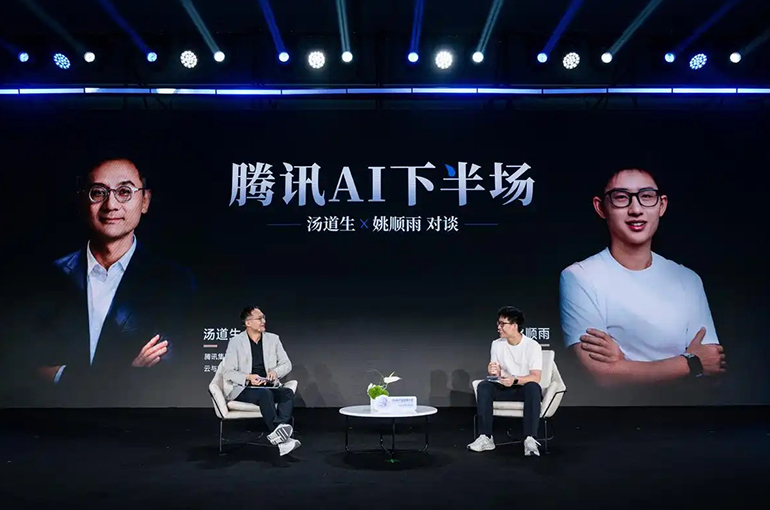
“AI is a long-term game,” Yao Shunyu, Tencent’s chief AI scientist since last December, said today at the Tencent Cloud AI Industry Application Conference, the company’s annual AI product launch and strategic showcase event.
“In some ways, the second half of the AI race is only just beginning,” the former OpenAI researcher pointed out. “ChatGPT and Claude will not be the only two super-apps, and new opportunities will emerge.”
China needs to develop an organization dedicated to artificial general intelligence, a type of AI that can match or exceed human capabilities in nearly all areas, Yao said. That organization will need to be built around a “balanced triangle” of solid foundational technology, products that generate value, and a frontier-minded spirit of exploration, he said.
Yao said there are many sentiments flying around Silicon Valley about AI, including the belief that everyone will lose their jobs in two years because the technology will replace them. “That is one view,” he said. “But our view is that AI is a long-term game.”
His most notable task so far has been working on the Shenzhen-based company’s Hy3 large language model, which Yao said has been improved in three key ways.
Tencent has rebuilt the model’s infrastructure, which includes the entire architecture for pre-training and reinforcement learning. It has also upgraded the data and evaluation systems, with a greater emphasis on defining real-world problems and improving data quality. The LLM is now capable of more human-like decisions based on “taste,” including hiring, setting the pace of model development, and weighing various trade-offs.
Yao also noted the unfavorable tendency in the Chinese AI sector to focus on leaderboard rankings. It is more important, he said, to build AI based on practical products and applications, and to recognize that practical usefulness matters more than “gaming the rankings.”
At the conference, Tang Daosheng, a senior executive vice president at Tencent, said most of the company’s code is being generated by AI this year. This means engineers can spend more time on tasks such as architecture design, as they have delegated the bulk of the coding work to AI, while providing regular guidance and corrections.
Editor: Tom Litting





