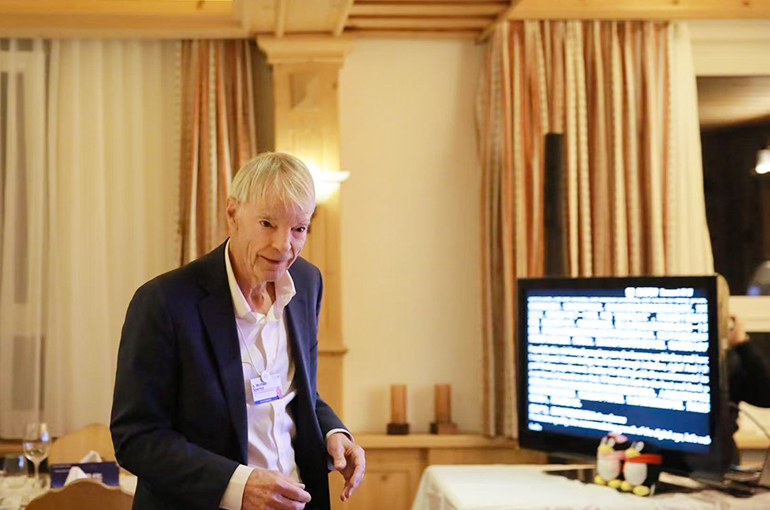
 'Trade Is Not Falling Off,' Nobel Prize Winner Michael Spence Says at Special Meeting in Davos
(Yicai) Jan. 22 -- "Trade is not falling off," Michael Spence, winner of the Nobel Prize in Economic Sciences in 2001, said at a special meeting during the World Economic Forum in Davos, Switzerland.
"The notion that this is sort of collapsing is just probably wrong," Spence said yesterday at the Tencent Finance WEF Vision Dinner, which had Yicai Global as media partner.
Despite the United States being a disruptive force, it only accounts for 25 percent of the global gross domestic product, with the remaining 75 percent continuing to operate under an evolving multilateral system that has rules and norms, Spence explained.
"The thing that gives me optimism is -- and I give all of you in China the credit for being the innovators in the proliferation of inclusive growth patterns -- technology," he noted. "The digitally enabled payment system, the digitally enabled credit systems, the use of artificial intelligence to deliver expanded services to remote populations is something that preceded first in China and is now being imitated all over the world."
Spence sees AI's most immediate global impact in biomedical science rather than commercial applications. He cited AI platform AlphaFold as an example. Its protein folding technology is now used by three million researchers across 190 countries as evidence that scientific collaboration transcends geopolitical tensions.
On AI's broader economic effects, Spence cautioned against premature conclusions. Institutions are still determining optimal uses, and the technology itself changes every three months, making long-term predictions unreliable.
Fragmentation is real but partial, according to analysts. One-quarter of the global economy may be reorganizing around security concerns, but three-quarters continues integrating around innovation, trade, and shared technological infrastructure.
For businesses and policymakers, the challenge is not navigating the total collapse of globalization but rather operating across an increasingly bifurcated system where different rules apply to different economic zones, analysts believe.
Editor: Futura Costaglione