



 How Can China, ASEAN Ease Aging Pressures?
(Yicai) April 29 -- Member countries of the Association of Southeast Asian Nations generally face structural gaps in elderly care systems, such as falling into poverty due to illness and the fear of losing their independence in old age, which undermine dignity in later life, according to two reports recently released by the ASEAN–China Silver Economy Development Research Center in Bangkok yesterday.
The development of the silver economy in China and the ASEAN should therefore prioritize cross-border elderly care, age-friendly technologies and more efficient allocation of elderly human resources.
Not a Retirement Paradise
ASEAN is far from being a 'retirement paradise,' according to the first report entitled ‘Survey on Public Opinion in the Silver Economy Across the 10 ASEAN Countries,' which was based on 305 respondents in the 10 ASEAN countries and 403 respondents in China and Thailand. Instead, it faces widespread structural weaknesses in its social security systems.
More than 75 percent of respondents said they are concerned about financial security after retirement. The widespread absence of this economic security is a fundamental issue.
In addition, an ‘overwhelming strain on medical resources’ and a ‘lack of nursing skills’ have created a double burden. Nearly 70 percent of respondents said they struggle with long hospital waiting times and high medical costs, while more than 66 percent of families admit that their relatives lack basic caregiving skills.
The report also highlights a clear digital divide. About 66.5 percent of elderly respondents feel excluded from digital life due to complex interfaces and difficult technology. At the same time, 55 percent fear online scams. As a result, the fact that senior citizens are 'unable and afraid to use' technology has become a major barrier preventing them from benefiting from digital services.
Differing Views
There are clear differences in living arrangements and expectations among the elderly in China and Thailand, according to the second report entitled ‘Survey Findings on Elderly Populations in China and Thailand,’ which is also based on 305 respondents in the 10 ASEAN countries and 403 respondents in China and Thailand.
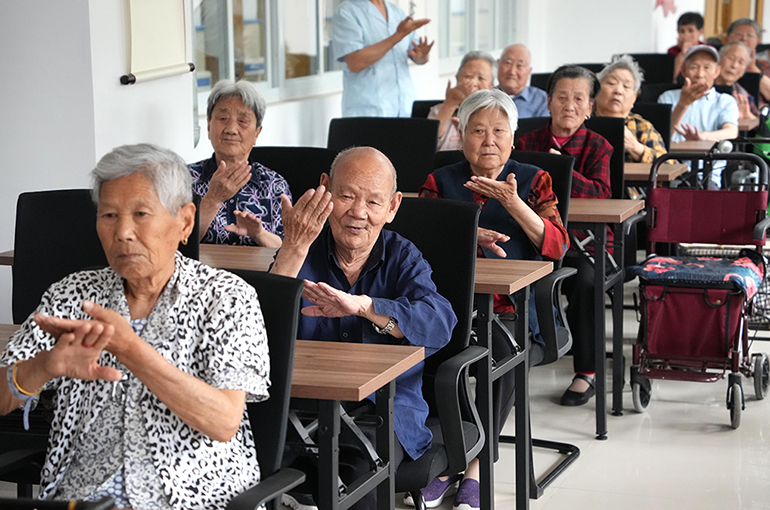
In China, 56.9 percent of elderly people live only with their spouse, reflecting a strong trend toward nuclear families becoming empty-nest households. In Thailand, a larger share still lives with children or extended family.
Interestingly, although more elderly people in China live alone, their satisfaction with family support is significantly higher than in Thailand at 58.2 percent versus 26.2 percent. This reflects a 'low expectations, high satisfaction' mindset among Chinese senior citizens, shaped by resilience and modest emotional expectations.
Over 70 percent of the elderly in China prefer a retirement focused on travel and personal enjoyment. By contrast, Thai seniors take a more pragmatic approach, with a higher willingness to continue working or start businesses. Only 12.5 percent of Thai respondents said they prefer to ‘live their own lives well.’ This reflects how different welfare systems shape perceptions of the value of the twilight years.
Insurance Gaps
The report also shows that Thailand’s elderly population faces a more complex disease burden, with higher rates of heart disease, respiratory illnesses and cancer. This places higher demands on healthcare services. Whereas in China, the main challenge is chronic disease management, especially hypertension, which affects 42.1 percent of senior citizens.
However, in terms of medical insurance, Thailand’s commercial health insurance coverage is close to 49 percent, while China still relies heavily on basic public medical insurance. This suggests significant growth potential for commercial insurers in Southeast Asia.
Policy Recommendations
Regardless of location, two issues consistently threaten dignity in old age, namely falling into poverty due to illness and the fear of disability, according to the two reports. Based on these findings, three recommendations are proposed for the future development of the silver economy.
The first is to break through institutional barriers for cross-border elderly care. More than 30 percent of senior citizens in ASEAN are open to retiring abroad, but inconsistent residency rules and the inability to interconnect medical insurance are major barriers. ASEAN and China should accelerate mutual recognition of long-term care insurance, cross-border medical settlement systems, and 'seasonal retirement' visa schemes to turn ASEAN into a more mobility-friendly area for the elderly.
The second is to use age-friendly technology to bridge the digital divide. The prevalence of heart and respiratory diseases in Thailand and large chronic disease burdens in China create strong demand for remote medical services and artificial intelligence-powered health monitoring. The focus should be on 'zero-learning-cost' technologies, using voice interaction instead of complex interfaces and shifting from passive use to proactive alerts.
The third is to shift from 'elderly care' to 'elderly participation.' Given the strong willingness among Thai seniors to continue working, countries could develop flexible platforms to reallocate senior labor resources. This would help ease labor shortages while improving financial security for the elderly.
The author, Yang Yifan, is a member of the expert committee of the National Working Commission on Aging.
 Yang YifanMember of the expert committee of the National Working Commission on Aging




