



 Order Gaps Drive Diverging Lunar New Year Holiday Plans for China’s Exporters
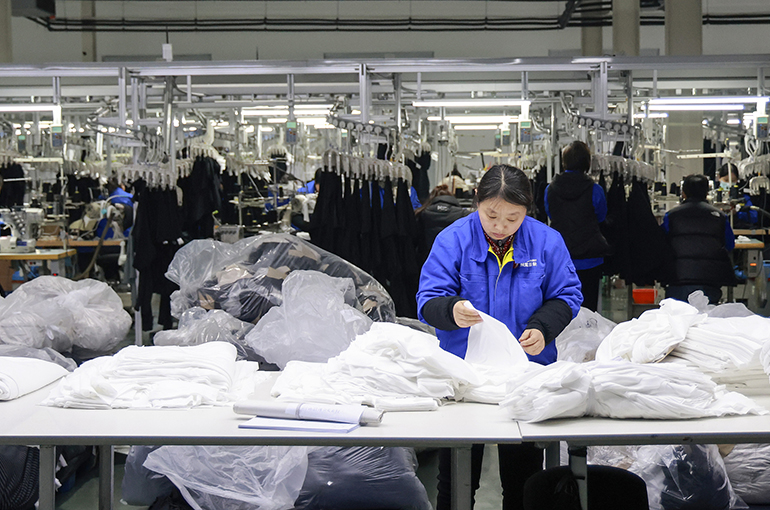
(Yicai) Jan. 28 -- Changes in the global trade environment are reshaping how Chinese exporters approach the period ahead of the Lunar New Year break. With order books diverging sharply, some firms have already begun their holiday shutdowns, while others are still working against the clock.
The head of an international freight forwarder told Yicai that clients’ holiday schedules are markedly polarized this year, with some closing early and others holding on until the last day. Overall demand is noticeably softer than in previous years, they noted.
This year’s Chinese New Year -- or Spring Festival as it is known in China -- falls on Feb. 17, with the official holidays running from Feb. 15 to 23. But private businesses may adjust their holiday schedules based on order volumes and production needs.
Rising global geopolitical risks and weak demand have led to a contraction in orders, according to Ding Yandong, a Zhejiang province-based foreign trade businessman. “Many factories have already started their holidays,” he told Yicai. Li Shiyong, a foreign trader in the Pearl River Delta region, similarly said that many traditional manufacturers have opted to shut early.
“The overall market situation isn’t good,” said Yao Dong, another Zhejiang-based exporter who specializes in children’s clothing. He noted that the industrial park where his company is located began its holiday this week, about a week earlier than in past years.
Even so, Yao said his own workload has surged in recent days, forcing him to do overtime as orders from emerging markets remain strong. With demand exceeding production capacity, his company will start its holiday later than usual, he noted.
Yao attributed this to his firm’s successful expansion into overseas markets in recent years. As China’s market for children’s apparel has contracted sharply, the company has established footholds in Southeast Asia and Russia and set up overseas warehouses in Japan and South America.
Although the firm’s exact order value for last year has yet to be finalized, Yao is confident that it almost certainly posted double-digit growth.
Wang Xiaonan, a hardware tools merchant based in Yiwu, told Yicai that her company will not start the holiday early this year, citing strong progress in expanding into emerging markets. She said the company’s products are being showcased overseas and that she plans to open a new branded store in Thailand during the holiday period while her Yiwu outlet is closed.
Wang said she feels far busier ahead of this year’s Lunar New Year than in previous years. Higher US import tariffs have pushed Chinese exporters to accelerate their push into emerging markets and build independent brands. As a result, although her company’s US sales grew more slowly last year, total exports still rose by over 20 percent.
The head of an auto parts supplier in the Yangtze River Delta region told Yicai that the company has yet to set its holiday start date but will not close early. While orders in 2025 were slightly lower than the year before, the recent launch of several new projects has kept capacity utilization high, making pre-holiday production particularly busy, the boss noted.
China's imports and exports rose 3.8 percent to record CNY45.47 trillion (USD6.55 trillion) last year, retaining its position as the world’s largest goods trader, according to data from the General Administration of Customs. Strong exports of high-tech, high-value-added, and green products helped offset declines in traditional labor-intensive goods.
Editors: Tang Shihua, Futura Costaglione





