



 Bringing Confidence Back to the Market: China’s New Real Estate Regulations
(Yicai) Sept. 23 -- On August 28, regulators released a sweeping package of new rules aimed at rebuilding the financial model that underpinned China’s property boom. To understand what they're fixing and why they are fixing it, it helps to compare China's ongoing real estate downturn with the US housing bust of the mid-2000s.
The American property market meltdown was caused by a collapse in underwriting standards. Traditionally, a bank would assess a borrower’s creditworthiness and hold the mortgage on its own books. By the early 2000s, the mortgage loan process had become specialized. Standalone mortgage companies approved borrowers for loans. They would sell the mortgage into a securitization pipeline and hold none of the risk themselves. Because they did not bear the consequences of a bad loan, mortgage companies had little incentive to rigorously assess a borrower's ability to repay. As a result, lenders extended credit to sub-prime and other non-conforming mortgage loans including those to NINJA (No Income, No Job, No Assets) borrowers.
Borrowers with poor credit scores were enticed with adjustable-rate mortgages that offered low, fixed “teaser” rates for the first two or three years and then reset to a much higher level. Research by economists at the Federal Reserve found that these adjustable-rate borrowers systematically underestimated, or simply did not know, by how much their rate could reset. This misunderstanding was most pronounced among lower-income and less-educated borrowers who did not budget for the inevitable increase in cost. By March 2008, more than a quarter of subprime adjustable-rate mortgages were seriously delinquent or in foreclosure, up from about 5.5 percent just three years earlier.
While the US subprime crisis was the result of too much lending going to unqualified borrowers, China’s housing downturn resulted from property developers’ excessive leverage.
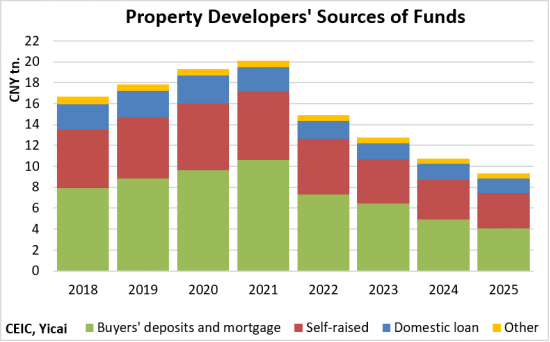
Given the high cost of urban land in China, particularly in major cities, property developers face large upfront costs which need to be financed. Chinese regulators were mindful of the potential costs developers’ leverage could pose to the domestic financial system, so they guided banks and trust companies to keep their exposures to developers prudent. As a result, developers relied on the funds they raised themselves (a mix of equity and non-bank borrowing) and those they borrowed from buyers (deposits and mortgages) as their key sources of finance.
Under China's presale system, which had been in place since 1994, a developer could sell an apartment unit once construction spending reached as little as 25 percent of total project investment. As a result, buyers routinely paid deposits, down payments and full mortgage proceeds to developers years before a building was complete. Developers could access these funds and use them to finance other projects. At the peak of the market in 2021, funds raised from homebuyers accounted for 53 percent of all the financing raised that year, with the developers’ self-raised funds making up an additional 33 percent (Figure 1).
Figure 1
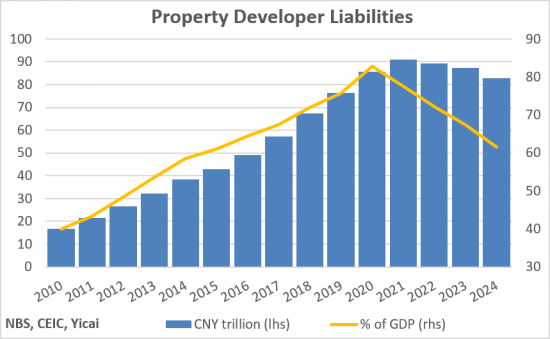
Despite limiting developers’ sources of funds, the boom in China’s property market made it easy to raise finance. By 2020, developers’ liabilities had ballooned to just under CNY 86 trillion or 83 percent of GDP (Figure 2). Guo Shuqing, the then Chairman of the China Banking and Insurance Regulatory Commission, called real estate the biggest threat to China’s financial stability, referring to it as a “grey rhino” – a highly probable and potentially high-impact risk, but one that attracts insufficient attention.
Figure 2
In August 2020, regulators tried to get ahead of the mounting financial stability risks by implementing a series of leverage caps – the so-called Three Red Lines. These tighter rules, compounded by the outbreak of Covid-19, triggered a 27 percent drop in new housing sales in 2022. Sales fell by an additional 17 percent in 2023. With developers reliant on a steady stream of new presale receipts to service existing debt, falling sales quickly triggered a series of defaults. By September 2023, 35 of the top 50 private sector developers had defaulted on their off-shore debt. Buyers, uncertain of the developers’ creditworthiness, became increasingly unwilling to pay in advance for as yet unbuilt apartments.
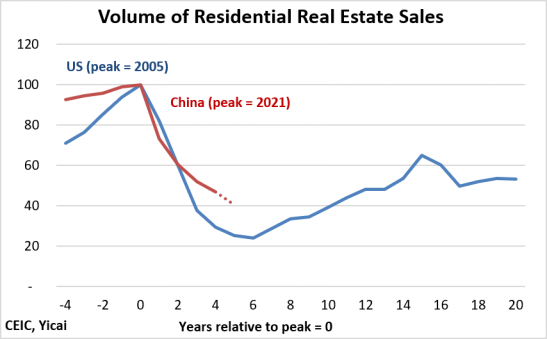
While the origins of the US and Chinese housing downturns were different, both countries experienced a dramatic drop in the volume of residential sales. Five years after their peak, the volume of US home sales was down 75 percent. Last year, a full two decades after reaching their peak, the volume of home sales remained only 53 percent as high as in 2005. The fall in the volume of Chinese residential sales has been only slightly less pronounced. Given the data through July, sales this year are likely to be some 59 percent lower than their 2021 peak (Figure 3).
Figure 3
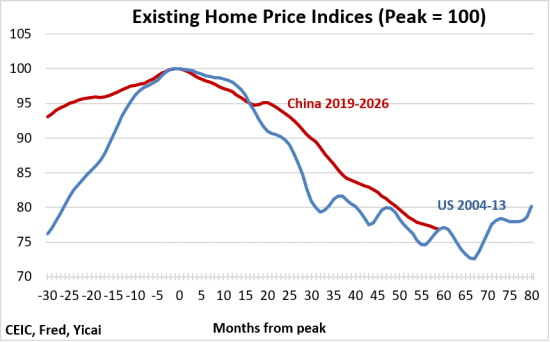
The extent of home price declines has been surprisingly similar in the US and China. In the US, existing home prices peaked in July 2006. As the housing crisis unfolded, they trended down for 68 months and only reached their trough in January 2012, five years and eight months later. China’s home prices peaked in July 2021. To date, they have fallen by 23 percent, almost exactly the same five-year rate of decline as recorded in the US (Figure 4).
Figure 4
The big difference between the housing busts in the two countries has been the scale of the macroeconomic impacts. In the US, the property market crash led to the Great Recession, the largest economic downturn since the Great Depression of the 1930s. This was, in part, because faulty financial innovation allowed dubious-quality mortgages to be repackaged as investment-grade securities. Many such securities were purchased by institutional investors worldwide who trusted the credit ratings that mischaracterized the underlying risk. When mortgage defaults exposed their true value, a fire sale ensued. Investors experienced large, unexpected losses, which had huge knock-on macroeconomic effects.
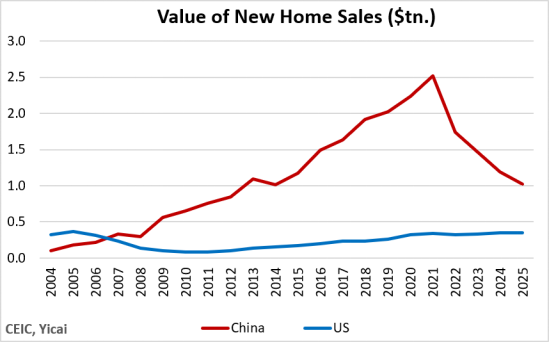
At the top of the market in 2005, the value of US new home sales was twice as large as those in China. In the subsequent decade and a half, the Chinese residential real estate market boomed, and by 2021, new home sales in China were 7 times as large as those in the US (Figure 5).
Figure 5
Notwithstanding the huge size of the market, the downturn in Chinese real estate has not had a large impact globally. This is because foreign exposure to the sector was small. At the market’s peak in 2021, foreign finance accounted for only 0.1 percent of the year’s funding. Chinese risk was concentrated in buyer prepayments and developers’ own funds.
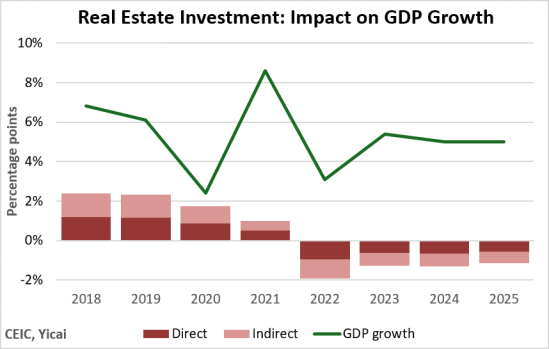
The collapse of the market has had serious domestic consequences. Before the pandemic, the combined direct and indirect effects of the boom in residential real estate investment added some 2 percentage points to GDP growth (Figure 6). This was roughly a third of the total over 2018-19 (we use the methodology described here to assess the contribution of residential real estate investment to GDP growth).
In 2022, the first year of the downturn, residential real estate subtracted 2 percentage points from growth. Between 2023 and 2025, it reduced growth by one and a quarter percentage points, on average.
Figure 6
In China, much of the fallout from the crisis has landed on homebuyers who paid for apartments they never received. In addition, uncertainty over developer creditworthiness is itself holding back sales, as buyers hesitate to prepay for units that may not be finished. The August 28 regulations target this problem directly, starting with the presale system.
Presales are not being abolished but they are becoming subject to stricter rules. Developers may still sell apartments before a building is finished, but only once its main structure has been topped out. This is much later in the construction process than the previous threshold of 25 percent of project investment. Moreover, rather than releasing the buyer's mortgage funds once a presale contract is signed, a "lead bank" will now hold the homebuyers' funds in ring-fenced accounts and not allow the developer to divert them for other uses. They will be released to the developer once the project has been registered as complete.
The new rules imply a financing crunch for developers, since buyers' money will arrive later in a project's life. Development loans are meant to help fill the gap. The same lead bank that holds the homebuyer’s mortgage will make the development loan, putting all of the relevant funds under one roof and making the financing more transparent.
Previously, there had been no unified national timetable for these loans, which typically ran only two or three years. The assumption was that presale proceeds would be used to pay them down as soon as possible. Under the new rules, loan terms are instead matched to a project's construction cycle, running up to five years for presale projects and up to seven for projects selling completed homes, with the first repayment of principal generally due once the project is completed.
The financing crunch will also be mitigated by allowing developers to pay local governments for land in installments rather than in one upfront sum. Regulators are encouraging developers to use capital markets as a further source of funds. The basis for that financing is shifting too, from a developer's overall creditworthiness to the quality of each individual project, with new rules supporting equity placements, bond issuance, and REITs backed by rental housing and other real estate assets.
The new property regulations are designed to bring buyers back to market by making it safe to prepay for an unfinished apartment. But the American experience suggests that China may never again see the return of the boom years’ frothy markets. While the rules appear to be a big step forward in making the system more transparent and trustworthy, confidence, once lost, does not necessarily return on a regulator's timetable.
 Mark KrugerBased in Shanghai, Mark Kruger holds Senior Fellow appointments at the Yicai Research Institute, the Centre for International Governance Innovation and University of Alberta’s China Institute. Between 2020 and 2023, Mark was the Opinion Editor at Yicai Global. Previously, he had a 30-year career with the Bank of Canada in the course of which he served as a Senior Advisor to the Canadian Executive Director at the IMF and the head of the Economic and Financial Section of the Canadian Embassy in Beijing.




