 Global Imbalances: The Case Against Panicking
(Yicai) Aug. 19 -- After a decade in which they had largely faded from the headlines, global imbalances have returned to the center of international economic debate.
Understanding Global Imbalances, a fulsome analysis of their causes and risks, was presented to the IMF Executive Board in April. According to this policy paper, capital flows from surplus countries can create vulnerabilities by depressing global interest rates and encouraging risky leverage. A loss of confidence in deficit countries’ ability to bear their liabilities can precipitate exchange rate volatility and increase the odds that access to international finance will dry up.
These forces raise the possibility that the imbalances will unwind in a disorderly fashion, as capital flows reverse abruptly and asset prices correct sharply. Indeed, this is one of the paper’s central concerns. In addition, it notes that global imbalances carry political-economy risks. Concentrated job losses can fuel protectionism even when aggregate gains from cross-border trade and investment are positive.
Global Imbalances: Old Questions New Answers, a companion blog post by Pierre-Olivier Gourinchas and Christian Mumssen, discourages protectionist policies. The authors note that current account balances are “widening again, reversing a decade of steady decline following the global financial crisis.” But their key message is that these imbalances are best addressed by both deficit and surplus countries making macroeconomic adjustments and not via tariffs and industrial policy, which the authors characterize as costly with uncertain effects on the imbalances themselves.
It has long been understood that the cost of a disorderly unwinding does not fall symmetrically on deficit and surplus countries. The loss of foreigners’ confidence could be disastrous for a deficit country. A “sudden stop” would force an abrupt currency depreciation, a sharp increase in borrowing rates and a recession. On the other hand, a surplus country could see slower exports and possible currency appreciation. These are very real but relatively manageable costs.
John Maynard Keynes recognized this asymmetry at the 1944 Bretton Woods conference. Given that there was little way to incentivize them to expand domestic demand, he proposed imposing penalty charges on countries that ran persistent surpluses. Keynes’s proposal was rejected and this asymmetry – adjustment is disproportionately borne by deficit countries – has been a feature of the international monetary system ever since.
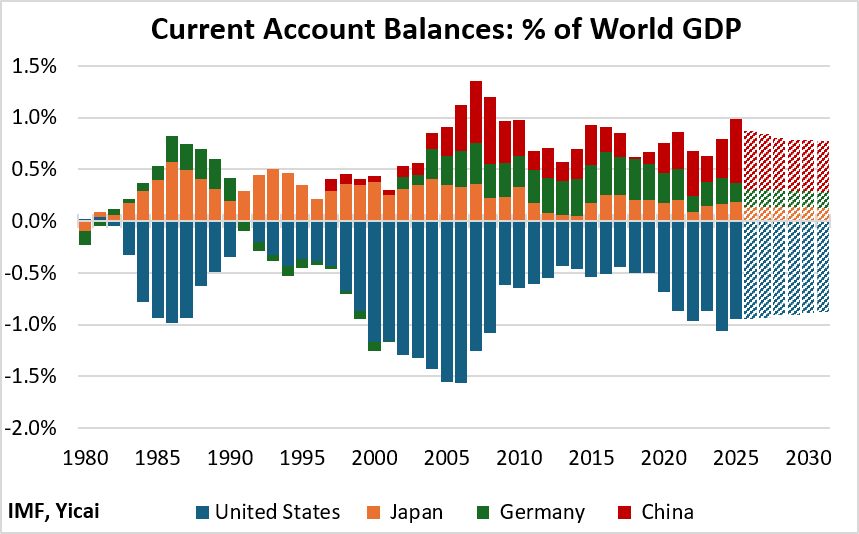
According to the IMF’s policy paper, the US, China, Germany and Japan account for two-thirds of global imbalances. The US’s deficits and the surpluses of the other three have doubled to close to 1 percent of global GDP in 2025 from their level ten years earlier (Figure 1). The Fund’s April 2026 World Economic Outlook forecasts that they will stabilize at this level through 2031. However, seen in the context of recent history, this level of imbalances does not seem alarming. They are significantly smaller than those recorded over 2000-08 and about as large as those in the 1984-87 period.
Figure 1
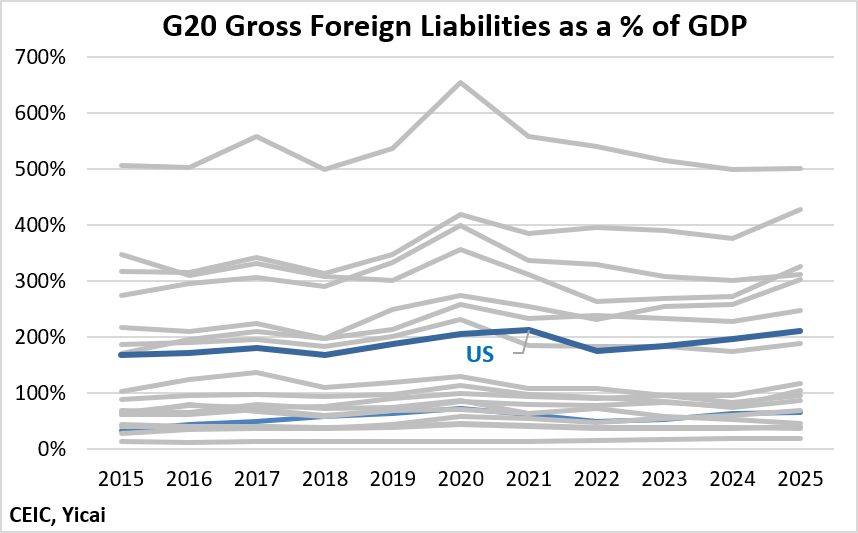
As the major deficit country, the US faces the risk of painful adjustment in the face of a sudden stop. One way to assess the likelihood of this risk is to see whether its indebtedness to foreigners has become extreme. The US’s gross foreign liabilities have risen by more than 40 percentage points of GDP over the last ten years. Still, its indebtedness does not appear to be excessive, compared to its G20 peers (Figure 2).
Figure 2
None of this means the imbalances are without explanation, or that their sources are irrelevant. Indeed, getting the analysis right matters more once the crisis narrative is set aside. The underlying saving and investment patterns are seen as evidence of manipulation or unfair advantage, rather than the predictable result of ordinary economic choices. This has led the policy debate to tariffs and industrial policy. But is that the right diagnosis?
A common way to look at global imbalances is through countries’ saving/investment mismatches. Deficit countries do not save enough, while surplus countries save too much.
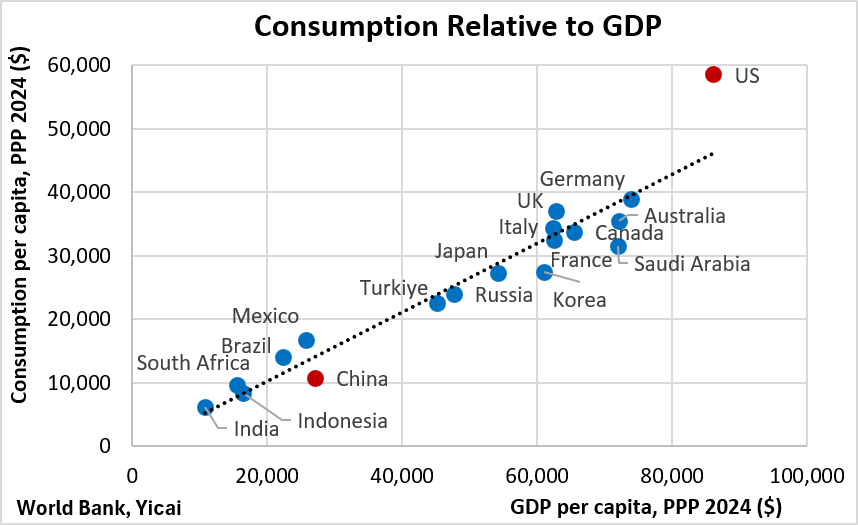
Figure 3 plots per capita household expenditure against per capita GDP, both measured in 2024 international dollars. Across the G20 countries, per capita household consumption is typically just over half of per capita GDP. The outliers are the US and China, where household consumption accounts for 68 and 40 percent of GDP, respectively. Relatively high household consumption in the US and low household consumption in China mirror the two countries’ current account positions.
Figure 3
Why do Chinese households spend so little relative to China’s GDP?
There is a widespread view that Chinese households’ incomes are suppressed, as resources are transferred toward investment, manufacturing, and local governments. Thus, a low share of national income is seen as causing below-average household consumption.
While this story is compelling, the framing is too negative. Countries can choose to consume today, or invest in tools that raise productivity and future consumption. Saving is simply the mechanism that allows resources to be invested. Deferring consumption today to consume more in the future is a mechanism as old as growth theory itself. One need not appeal to income suppression or coercion to explain this choice. Seen in this way, high household savings is a feature rather than a bug in China’s development model.
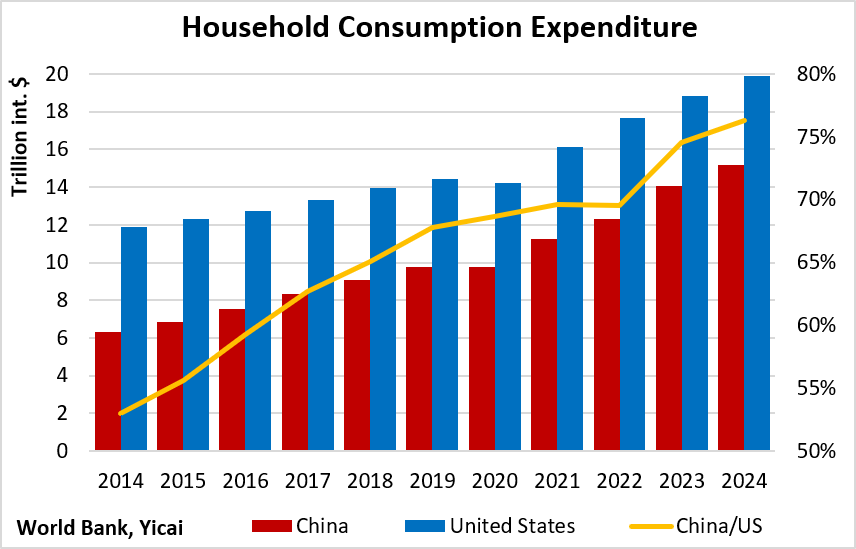
China’s consumption growth has been rapid. Data from the World Bank show that in purchasing power parity terms, which corrects for China’s relatively low price level, household consumption expenditure rose by 141 percent between 2014 and 2024, compared to just 68 percent in the US over the same period. As a result, aggregate Chinese household consumption rose from just over half to more than three-quarters as much as the US’s over the ten-year period (Figure 4).
Figure 4
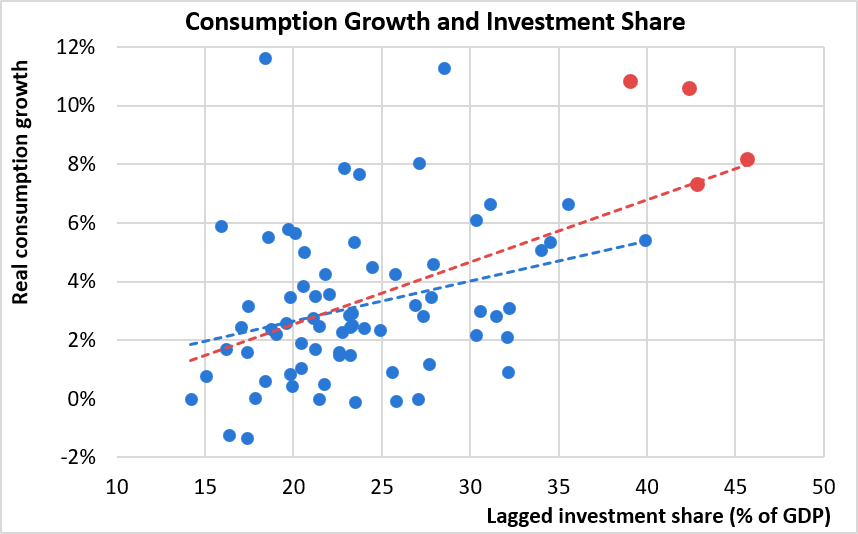
Looking across the G20 countries, we can see that higher investment rates are associated with more rapid future consumption. Figure 5 breaks the period 2000-24 into five five-year blocks. In each block, it calculates each G20 country’s average investment -to-GDP ratio. It then associates that ratio with average annual consumption growth in the subsequent 5-year block.
For all G20 countries, increasing the investment-to-GDP ratio by 5 percentage points raises average annual consumption growth by more than a percentage point in the subsequent five-year period (the red dashed line). Eliminating China (looking only at the blue dots and the blue dashed line), the impact is still positive but somewhat smaller. The same increase in the investment rate raises average annual consumption growth by 0.7 percentage points.
Figure 5
And why do US households save so little?
Much of the discussion around low savings in the US revolves around the fiscal deficit, which has run about 6 percent of GDP in recent years. However, a more promising place to look for efficiencies is in healthcare spending. The US spends roughly 17 percent of GDP on health care, nearly double the 8–9 percent average of other G20 countries. It well out-spends its richer G20 peers – Germany, France, Canada, Japan, the UK, Australia, Italy, and South Korea – which average about 11 percent of their GDPs.
Notwithstanding its outsized outlays, US life expectancy over 2020–24 averaged 77.6 years, statistically indistinguishable from the 77.4-year average of the other eighteen G20 members, and nearly five years lower than the 82.4-year average of its high-income peers (Figure 6). China, by contrast, spends only about 5.6 percent of GDP on health and achieves essentially the same outcome (78.1 years).
Figure 6
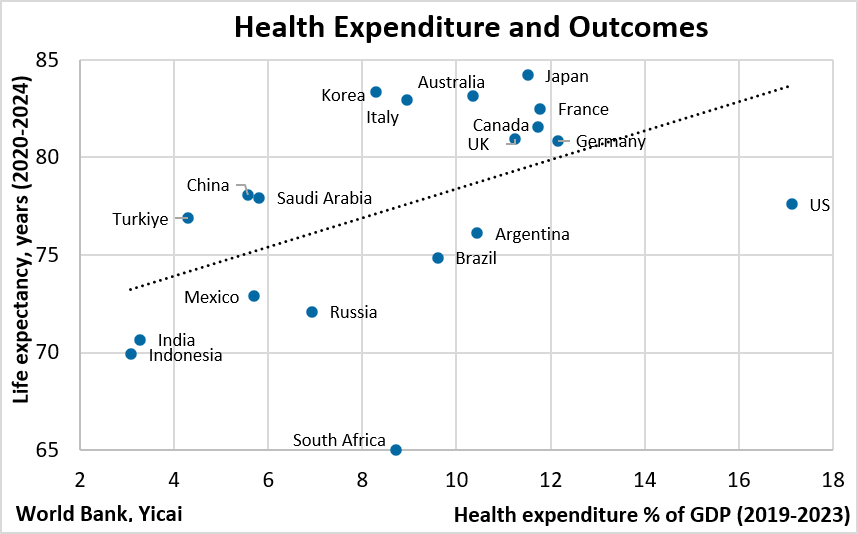
Much of the US's excess health spending relative to its peers is not adding value. It reflects administrative complexity, provider and insurer pricing power, and fragmented, high-overhead financing rather than additional care that improves outcomes.
This suggests that health care reform could be a less expensive way to shrink the US current account deficit than conventional fiscal consolidation. Closing the deficit through tax increases or spending cuts is contractionary. It withdraws demand from the economy and slows growth.
Reducing US health spending toward the rich-peer norm would entail a reduction in consumption of 5 to 6 percentage points of GDP. This would be more than enough to close the current account deficit. Such reform will not be easy. It means confronting concentrated interests of the medical, pharmaceutical and insurance industries rather than the diffuse taxpayer base. But it would be materially cheaper, in economic terms, than closing the same gap through austerity.
In short, the two most common narratives around global imbalances do not hold up well.
First, today's imbalances are not a re-run of the buildup to the Great Recession. They remain well below their 2000s peak. Moreover, the US's external position, while worse than a decade ago, is not out of line with its G20 peers. While the 2008 crisis is often misremembered as caused by global imbalances, research points to failures in financial regulation and bank risk management, not capital inflows from surplus countries, as its proximate cause.
Second, the idea that China's low household consumption reflects income suppression, and that America's low saving reflects fiscal indiscipline, mistakes the mechanism for the malady. China's investment rate has coincided with, and plausibly driven, one of the fastest consumption growth records among major economies. And the US's shortfall in saving traces less to the federal deficit than to a health care system that spends far more than its peers without buying better outcomes.
If Washington wants a smaller current account deficit, health care reform is a far more direct and less costly lever than austerity or protectionism. And if the aim is to see China consume a larger share of its own output, the relevant question isn't how to force households to spend more, but how much longer China's investment-led growth model can keep delivering the consumption gains that have, hitherto, made deferred spending a reasonable bargain.
 Mark KrugerBased in Shanghai, Mark Kruger holds Senior Fellow appointments at the Yicai Research Institute, the Centre for International Governance Innovation and University of Alberta’s China Institute. Between 2020 and 2023, Mark was the Opinion Editor at Yicai Global. Previously, he had a 30-year career with the Bank of Canada in the course of which he served as a Senior Advisor to the Canadian Executive Director at the IMF and the head of the Economic and Financial Section of the Canadian Embassy in Beijing.